
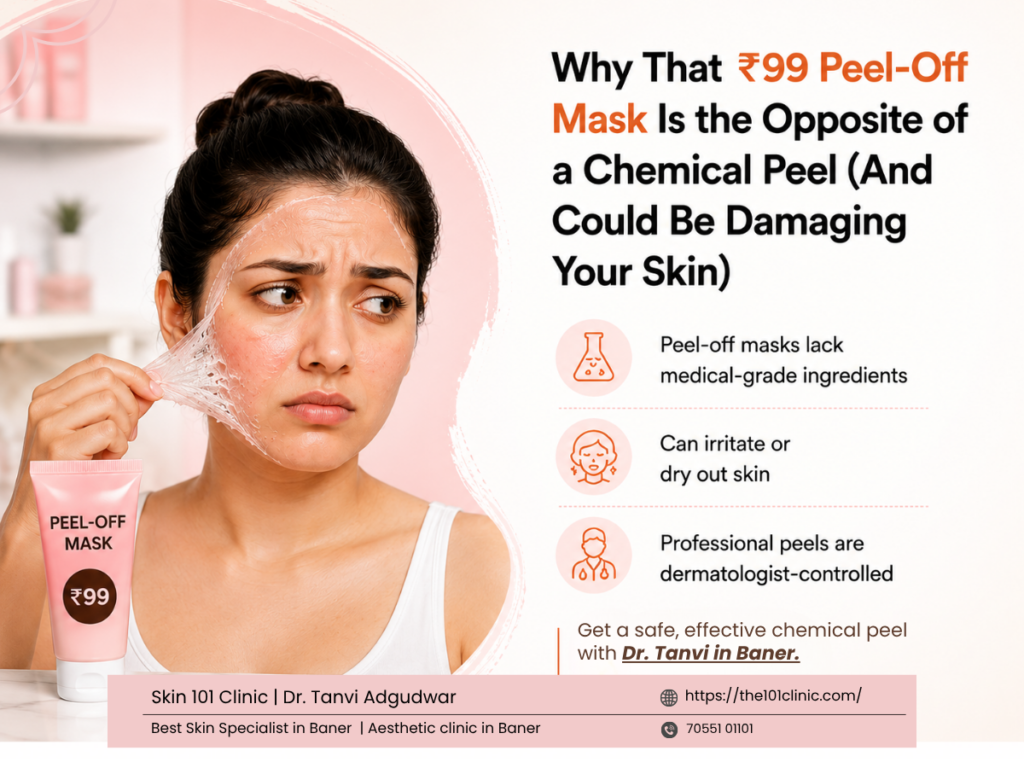
If you have ever pulled a stiff, glue-like film off your face and felt that oddly satisfying rip, you already know why peel-off masks are all over Instagram reels. They are cheap, they are fun to film, and they promise the same glow-up results people associate with an in-clinic chemical peel. Except they are not the same thing at all. In fact, dermatologists say the two are almost opposites in how they work on your skin.
As someone who sees the aftermath of both good and bad skincare choices in clinic every week, I want to break down exactly what a peel-off mask is doing to your face, how it differs from an actual chemical peels treatment, and why that ₹99 impulse buy might be costing you more than you think in the long run.
What Happens When You “Peel” Your Skin at Home
A drugstore peel-off mask is usually made from polyvinyl alcohol, a plastic-like adhesive that also happens to be used industrially to laminate safety glass. When you apply it, it dries into a film that physically bonds to the outermost layer of your skin, the stratum corneum. When you pull it off, that film does not just lift away dirt and blackheads. It also rips off:
- A layer of healthy, living skin cells, since the peeling motion can disrupt the skin barrier and lead to a lot of irritation, according to board-certified dermatologist Dr. Devika Icecreamwala
- Fine facial hair (peach fuzz), which can cause micro-tears and inflammation similar to waxing
- Sebum and natural lipids that your skin barrier actually needs to stay protected
This matters more than it sounds like, because your skin barrier is remarkably thin. It is only 10 to 40 micrometers thin, or about one thousandth of a millimeter, which is thin enough to be damaged by one poorly formulated skincare product. Repeated mechanical pulling on skin this delicate can also affect its underlying support structure. Some estheticians note that repeatedly pulling the skin to remove a mask can rob it of elasticity, resulting in saggy or loose skin over time.
There is also the allergy risk. Because these masks rely on adhesive-like ingredients to create the “peel” effect, the acrylates used can trigger allergic contact dermatitis, leading to itching, redness, and in some cases blisters.
Real Chemical Peels Work the Opposite Way
Here is the part most people misunderstand: an actual chemical peels treatment does not rely on mechanical force at all. There is no pulling, ripping, or ripping out of hair follicles. Instead, a professional chemical peel uses controlled acid solutions, such as glycolic acid, salicylic acid, lactic acid, or TCA, applied at a specific concentration and left on the skin for a measured amount of time.
The key differences come down to how the exfoliation actually happens:
- Mechanism: Peel-off masks use physical adhesion and force. Chemical peels use a chemical reaction that gently loosens the bonds between dead skin cells so they shed naturally over the following days.
- Control: A dermatologist adjusts the acid type, strength, and application time to your exact skin type and concern, whereas a mass-produced mask uses the same formula on everyone regardless of skin sensitivity.
- Downtime and aftercare: A proper chemical peels treatment is followed by barrier-supportive products and sun protection guidance, so your skin heals in a structured way instead of being left raw and vulnerable.
- Depth of action: Peels can be tailored to work at a superficial, medium, or deeper level depending on the concern, from pigmentation to acne scars, something a one-size-fits-all sachet mask cannot replicate.
Because a chemical peel dissolves rather than tears, it does not compromise the skin’s elasticity or strip its lipid matrix the way a peel-off mask does.
Signs Your Skin Is Reacting, Not Improving
It is easy to mistake short-term redness or “smoothness” after a peel-off mask for a good result. But dermatologists caution this is often just the sign of a stripped barrier. Watch out for:
- Tightness, stinging, or redness that lasts for hours after removal
- Increased sensitivity to your regular moisturizer or sunscreen afterward
- New breakouts appearing days later, since a compromised barrier struggles to regulate oil and bacteria
- Visible dryness or flaking that was not there before
If you notice these patterns, it is worth pausing peel-off masks altogether. As one clinical source puts it, your skin barrier is left slightly vulnerable right after any peeling process, and limiting use to once or twice a week at most matters because overdoing it can damage the barrier, and that guidance is really written for professionally formulated products, let alone a ₹99 mass-market sachet.
What To Do Instead
If your goal is smoother, brighter, more even-toned skin, a supervised chemical peels treatment remains one of the most researched and predictable ways to get there, precisely because it is dosed and monitored by a professional rather than left to a one-size-fits-all mask. Between clinic visits, gentler exfoliants like low-strength AHA or BHA serums, and hydrating, barrier-supporting masks are a far safer way to maintain results without the mechanical trauma of pulling off a plastic film.
Read More –
- Your Complete Guide to Trying Chemical Peels at Home
- Scared of Skin Treatments? A Dermatologist Answers the 7 Fears That Are Holding You Back
- Skincare Routine Not Working? 7 Signs It’s Time to See a Skin Specialist
Get It Done Safely at Skin 101 Clinic
At Skin 101 Clinic, under the guidance of Dr. Tanvi Komawar Adgudwar, every chemical peels treatment in Baner is customized to your skin type, concern, and tolerance, using medical-grade formulations rather than guesswork. Whether you are dealing with pigmentation, acne marks, dullness, or early signs of aging, the clinic’s approach focuses on strengthening your skin barrier while delivering visible results, not stripping it for a quick Instagram moment. If you have been relying on drugstore peel-off masks and noticed more irritation than glow, it may be time to switch to a chemical peels treatment in Baner that is actually designed with your skin’s long-term health in mind.
Frequently Asked Questions
- Is a peel-off mask the same as a chemical peel? No. A peel-off mask physically pulls off the top layer of skin using an adhesive film, while a chemical peels treatment uses acid solutions to gently dissolve the bonds between dead skin cells. The mask relies on mechanical force, while a professional peel relies on a controlled chemical reaction, which is why peels are generally safer for regular use.
- Can peel-off masks cause permanent skin damage? Frequent use can lead to a weakened skin barrier, increased sensitivity, and reduced elasticity over time, especially with repeated pulling on delicate facial skin. Occasional use on healthy skin may not cause lasting harm, but daily or weekly use, especially on sensitive or acne-prone skin, raises the risk of cumulative damage.
- How often can I safely get a professional chemical peel? This depends on the type and strength of the peel used, as well as your skin type, but most superficial chemical peels treatment sessions are spaced two to four weeks apart to allow the skin barrier to recover fully between sessions. A dermatologist like Dr. Tanvi Komawar Adgudwar can create a schedule based on your specific skin goals and sensitivity.
#SkincareScience #ChemicalPeel #SkinBarrier #DermatologistApproved #SkinCareTips #PeelOffMask #GlowingSkin #Skin101Clinic #BanerSkinClinic #HealthySkin