
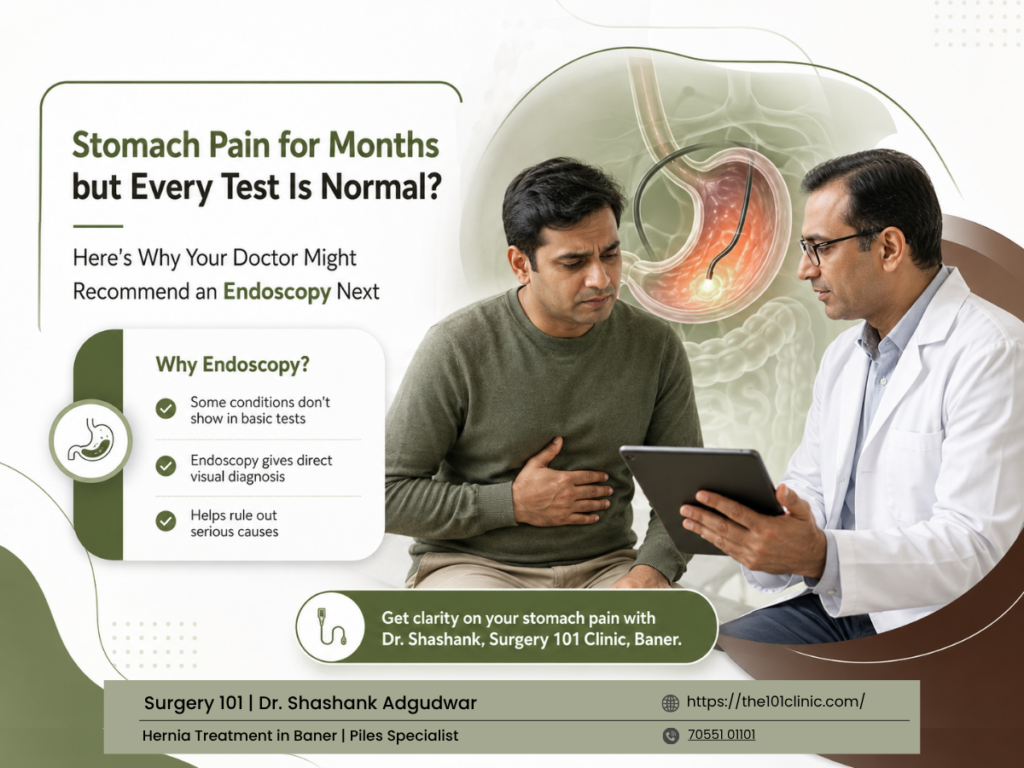
If you’ve been dealing with stomach pain for weeks or months, and every blood test, ultrasound, and scan keeps coming back “normal,” you’re probably frustrated. You know something isn’t right, yet the reports say otherwise. This is one of the most common and confusing situations in gastroenterology, and it’s more widespread than you might think.
Chronic abdominal pain affects up to 21% of the general population and ranks as the eighth most common complaint patients bring to primary care , with prevalence reaching up to 21% in the general population and standing as the 8th most common complaint of all patients presenting in primary care for a health issue. So if standard tests haven’t found an answer for you, you’re not alone, and there’s usually a next step. nih
That next step is often an endoscopy. Here’s why.
Why “Normal” Test Results Don’t Always Mean You’re Fine
Standard tests like blood work, ultrasounds, and even CT scans are excellent at spotting certain problems, but they have limits. They can miss subtle inflammation, small ulcers, early-stage tissue changes, or issues buried deep within the digestive tract that only become visible when a doctor can actually look inside.
According to Stanford Health Care, it’s actually common for people with recurrent abdominal pain to have normal test results , and that doesn’t mean the person isn’t sick, it simply means it may take time to fully understand the condition, though there’s plenty that can be done in the short term to help someone feel better. This is exactly where endoscopy treatment comes in, offering doctors a much closer, more direct look than imaging alone can provide. Stanford Health Care
What Can an Endoscopy Actually Detect?
An upper GI endoscopy involves a thin, flexible tube fitted with a tiny camera that’s passed through the mouth to examine the esophagus, stomach, and the beginning of the small intestine. Unlike scans, it lets the doctor see the lining of these organs directly and take a biopsy on the spot if needed.
Here’s what this procedure can help uncover when other tests come up empty:
- Ulcers and inflammation: Small ulcers or gastritis can cause persistent pain but may not always show up clearly on imaging.
- GERD-related damage: Chronic acid reflux, heartburn, or difficulty swallowing alongside abdominal pain can point toward esophageal irritation or even esophageal cancer in rare cases, which an endoscopy can help identify.
- Inflammatory bowel disease (IBD): Conditions like Crohn’s disease or ulcerative colitis often require direct visual examination of the intestinal lining to confirm inflammation or ulcers.
- Unexplained weight loss or appetite changes: When abdominal pain comes with these red-flag symptoms, doctors may use endoscopy to rule out abnormal growths or early tumors, since endoscopy allows for direct visualization of abnormal growths, and biopsies can be taken during the procedure to test for cancerous cells, with early detection significantly improving prognosis for patients with gastrointestinal cancers. Curasia
- Small bowel issues: In more complex or hard-to-pinpoint cases, doctors sometimes use capsule endoscopy, a pill-sized camera swallowed by the patient, which is especially useful for spotting unexplained bleeding, Crohn’s disease, or small bowel tumors that regular scopes cannot reach , since it involves swallowing a small, pill-sized camera that captures images of the digestive tract as it moves through. Curasia
When Do Doctors Usually Recommend It?
Endoscopy isn’t the first test doctors reach for. It usually comes after a thorough history, physical exam, blood work, and imaging haven’t given a clear picture. But timing and age also play a role in the decision.
Medical guidelines differ slightly here. The American College of Gastroenterology generally recommends considering endoscopy for new symptoms at age 60 and above, while the American Society for Gastrointestinal Endoscopy sets that threshold closer to 50, and notably, endoscopy is often not recommended even with certain red-flag symptoms in younger adults because of its lower predictive value in that age group , since the ACG guidelines establish the age for endoscopy with new symptoms at 60 years rather than 50 for the ASGE, and do not recommend endoscopy even in the presence of red flag symptoms for most individuals under 60 because of a low positive predictive value for detecting upper GI conditions. UHC Provider
That said, persistent pain lasting for months, especially when paired with symptoms like difficulty swallowing, unexplained weight loss, or ongoing digestive discomfort, is often reason enough for a doctor to recommend endoscopy treatment regardless of age, simply to rule out serious causes early.
What to Expect Before and During the Procedure
If your doctor recommends an endoscopy, it helps to know it’s a routine, minimally invasive outpatient procedure. Here’s a quick overview of the general process:
- Fasting beforehand: You’ll typically need to avoid food and drink for several hours before the procedure so your stomach is empty.
- Sedation: Most patients receive mild sedation to stay relaxed and comfortable throughout.
- The procedure itself: The endoscope is gently passed through the mouth, and the doctor examines the lining of your digestive tract in real time, taking biopsies if anything looks unusual.
- Recovery: Most people go home the same day and can resume normal activities within 24 hours, though driving is usually restricted right after sedation.
The entire process typically takes under 30 minutes, and results from any biopsies usually follow within a few days.
Read More –
- Frequent Acidity, Bloating, or Stomach Pain? Signs You Should See a Gastroenterologist
- Stomach Cancer vs Normal Indigestion – When to Worry
- Understanding Acid Reflux and How It Affects Your Stomach Health
Getting Real Answers with Surgery 101 Clinic
Living with stomach pain that no one can explain is exhausting, and chasing test after test without answers only adds to the stress. If you’ve reached that point, it may be time to talk to a specialist who can look deeper.
At Surgery 101 Clinic, led by Dr. Shashank Adgudwar, patients get access to advanced diagnostic care, including endoscopy in Baner, performed with modern equipment and a patient-first approach. The team takes time to understand your symptoms, history, and concerns before recommending any procedure, ensuring you’re never left guessing about your own health. Whether it’s persistent stomach pain, unexplained digestive issues, or a second opinion after normal test results, Surgery 101 Clinic offers thorough evaluation and clear, honest guidance every step of the way.
If months of stomach pain have left you without answers, don’t wait longer. Reach out to Surgery 101 Clinic and take the next step toward finding out what’s really going on.
Frequently Asked Questions
- Why would a doctor recommend an endoscopy if my blood tests and scans are normal?
Blood tests and imaging can miss subtle issues like small ulcers, mild inflammation, or early tissue changes inside the digestive tract. An endoscopy allows direct visual examination and biopsy collection, offering a level of detail that standard tests often can’t provide, which is why it’s frequently the next step when other results come back normal. - Is an endoscopy painful or risky?
Most patients undergo endoscopy with mild sedation, so discomfort is minimal, and the procedure is generally considered safe with a low complication rate. Recovery is quick, with most people resuming normal activities within a day. - How long does it take to get results after an endoscopy?
The procedure itself usually takes under 30 minutes, and if a biopsy is taken, lab results typically arrive within a few days. Your doctor will then discuss findings and outline any next steps or treatment options based on what was found.
#StomachPainRelief #EndoscopyTreatment #GutHealthMatters #DigestiveHealth #GastroCare #HealthAwareness #Surgery101Clinic #EndoscopyInBaner #WellnessJourney