
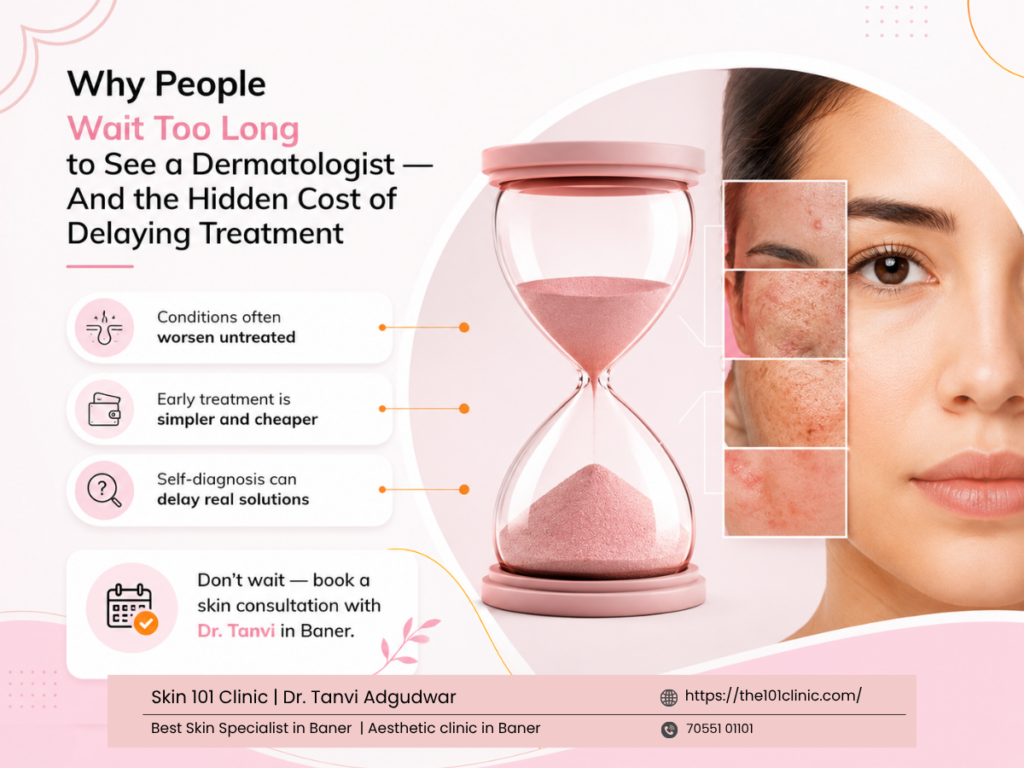
“It’s probably nothing.” “I’ll wait and see if it goes away.” “I don’t want to overreact.” These are the exact sentences we hear in clinic, almost word for word, from patients who waited months, sometimes years, before booking an appointment with a dermatologist.
Skin issues rarely feel urgent the way a broken bone or chest pain does. There is no sharp moment that forces you to act. And that quiet, low-pressure nature of skin problems is exactly why so many people put off care that could have been simple, quick, and far less stressful if addressed early.
Why Delay Feels So Easy When It Comes to Skin
Most patients are not ignoring their skin out of carelessness. The delay usually comes from a few very human, very understandable reasons.
- A spot or mole doesn’t hurt, so it doesn’t feel serious
- Busy schedules push “non-urgent” appointments to the bottom of the list
- Fear of a bad diagnosis makes avoidance feel safer than knowing
- Long wait times discourage people before they even try booking
- Assuming a rash or bump will resolve on its own with time
Research backs this up. A U.S. survey study found that even before the pandemic, dermatology access was already difficult, with average wait times of about 33 days for an appointment, and nearly two-thirds of appointments exceeding standard urgency benchmarks. When getting in is already hard, it becomes even easier to keep pushing the visit further down your list.
The Hidden Cost Nobody Talks About
Here is where delay quietly becomes expensive, not just in money, but in outcomes.
1. Early-Stage Problems Are Simpler to Treat
Almost every skin condition, from acne to precancerous lesions, is easier and less invasive to treat in its early stage. A basal cell or squamous cell skin cancer caught early has a five-year survival rate of well over 99 percent, but the treatment complexity, and the visible scarring risk, increases significantly the longer it is left unchecked.
2. Melanoma Survival Drops Sharply With Time
This is the statistic that should change how people think about “waiting it out.” When melanoma is caught while still localized to the skin, the five-year survival rate is around 99 percent. Once it spreads to nearby lymph nodes, that number falls to roughly 66 to 76 percent. If it spreads to distant organs, survival drops to around 27 to 35 percent. The difference between those numbers is, quite literally, time.
3. Delay Is a Documented Prognostic Factor
This isn’t just theory. A clinical study on squamous cell carcinoma patients found an average patient delay of nearly three years before seeking care, and researchers specifically noted the need for public awareness campaigns encouraging people to see a dermatologist as soon as they notice a suspicious skin change, precisely because delay directly affects prognosis.
4. Non-Cancer Conditions Get Harder to Reverse Too
It’s not only about cancer. Pigmentation, chronic acne, and inflammatory skin conditions tend to become more resistant to treatment the longer they are left untreated, often requiring longer, more expensive treatment plans than if they had been addressed within the first few months of onset.
Why Access and Awareness Both Matter
Part of the delay problem isn’t just personal hesitation. It’s structural. Studies have pointed out that a growing population, combined with a limited supply of dermatologists in many regions, has contributed to longer waits, which can unintentionally push higher-risk patients further back in the queue. This makes it even more important to act quickly once you do notice something worth checking, rather than assuming you’ll “get to it eventually.”
There is also a simple mindset habit worth building: the American Academy of Dermatology recommends regular self-skin checks and sun protection as everyday habits, not once-a-year afterthoughts, precisely because catching changes early is what makes the biggest difference.
When You Should Stop Waiting and Book a Dermatologist Visit
You do not need to wait for pain, bleeding, or visible spreading to justify an appointment. Some signals worth acting on right away include:
- A mole or spot that has changed in size, shape, or color
- A sore or patch that hasn’t healed in a few weeks
- Sudden or unexplained acne, rashes, or pigmentation changes
- Any new growth that looks different from your other moles
- A family history of skin cancer combined with a new or unusual spot
If any of these sound familiar, that “I’ll wait and see” instinct is exactly the one worth overriding.
Read More –
- Scared of Skin Treatments? A Dermatologist Answers the 7 Fears That Are Holding You Back
- When Should You Stop Self-Treating Skin Problems and Visit a Dermatologist? Key Warning Signs
- Dermatologist vs DIY Skincare: What Actually Works for Stubborn Skin Concerns?
How Skin 101 Clinic Helps You Stop Waiting
At Skin 101 Clinic, Dr. Tanvi Komawar Adgudwar believes the best outcomes come from acting early, not from waiting until a concern becomes unavoidable. As an experienced dermatologist in Baner, Dr. Tanvi offers thorough skin evaluations in a comfortable, judgment-free setting, so you never have to sit with uncertainty longer than necessary. Whether it’s a mole that looks different, persistent acne, or a skin change you’ve been putting off asking about, Skin 101 Clinic makes it simple to get answers early, when treatment is easiest and outcomes are best.
If something on your skin has been on your mind for a while, let this be the reminder to stop waiting and get it checked.
Frequently Asked Questions
- Why do people avoid going to a dermatologist even when something looks unusual? Most delays come from assuming a skin issue isn’t serious since it doesn’t hurt, along with fear of a bad diagnosis or difficulty finding appointment slots. Research shows average dermatology wait times can exceed a month, which often discourages people before they even try booking.
- Does waiting to see a dermatologist actually affect treatment outcomes? Yes, significantly. For melanoma, five-year survival rates drop from around 99 percent when caught early to as low as 27 to 35 percent once it has spread to distant organs, showing how much timing affects outcomes.
- What skin symptoms should never be ignored or delayed? Any mole or spot that changes in size, shape, or color, a sore that hasn’t healed in a few weeks, or a new growth that looks different from your other moles should be checked by a dermatologist promptly, especially if you have a family history of skin cancer.
#SkinHealth #Dermatologist #EarlyDetection #SkinCareAwareness #HealthyHabits #SkinCancerAwareness #DermatologistInBaner #PuneHealthcare #SkinCareTips