
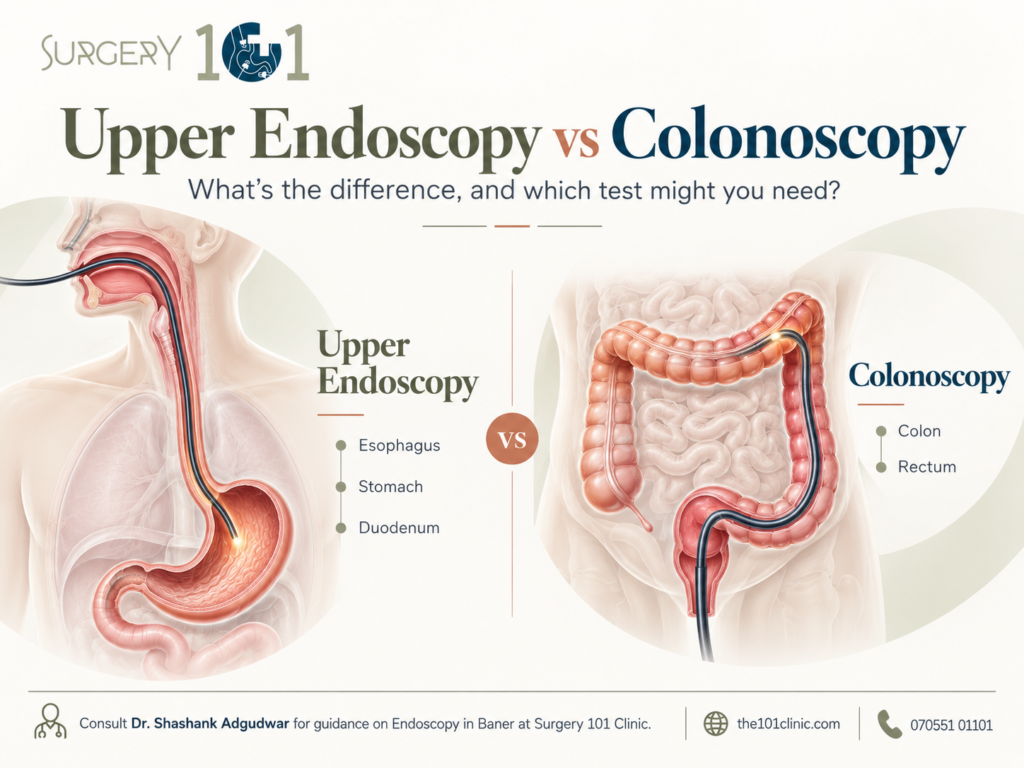
If your doctor recommends a camera test for digestive symptoms, you may hear the words “endoscopy” and “colonoscopy” and wonder whether they mean the same thing.
Both use a flexible tube with a camera to examine the digestive tract, but they look at different areas. An upper endoscopy examines the food pipe, stomach and beginning of the small intestine. A colonoscopy examines the rectum and colon.
The right test depends on your symptoms, medical history and what your doctor needs to investigate. One test does not replace the other.
What Is an Upper Endoscopy?
An upper endoscopy, also called a gastroscopy or upper GI endoscopy, usually involves passing a thin, flexible camera through the mouth.
It allows the doctor to examine the lining of the oesophagus, which carries food to the stomach, the stomach itself and the duodenum, the first part of the small intestine.
The test can help investigate swallowing problems, persistent upper abdominal symptoms and suspected bleeding. It can also identify inflammation, ulcers and other abnormalities. Small tissue samples, called biopsies, may be collected when needed. NIDDK
What Is a Colonoscopy?
A colonoscopy involves passing a flexible camera through the anus to examine the rectum and colon, which form most of the large intestine.
Doctors may recommend it to investigate rectal bleeding, persistent changes in bowel habits or other concerning symptoms. It is also used for colorectal cancer screening and follow-up in selected patients.
During the examination, the doctor may take biopsies or remove suitable polyps. Polyps are growths in the bowel lining; some can develop into cancer over time. Removing them can help reduce that risk. NIDDK
Upper Endoscopy and Colonoscopy at a Glance
| Feature | Upper endoscopy | Colonoscopy |
| Area examined | Food pipe, stomach and first part of the small intestine | Rectum and colon |
| Camera entry point | Usually through the mouth | Through the anus |
| Common reasons | Swallowing difficulty, persistent upper digestive symptoms, suspected upper digestive bleeding | Rectal bleeding, bowel habit changes, polyp assessment or cancer screening |
| Main preparation | Fasting according to instructions | Dietary changes, bowel-cleansing medicine and fasting instructions |
| Samples or treatment | Biopsies and certain treatments, such as controlling bleeding | Biopsies, polyp removal and certain treatments |
Both procedures examine the digestive lining directly. Neither routinely examines the entire small intestine.
How Does Your Doctor Decide Which Test You Need?
The decision starts with a consultation. Your doctor considers where symptoms occur, how long they have lasted, associated warning signs and previous test results.
For example, difficulty swallowing may lead to an upper endoscopy, while unexplained rectal bleeding may lead to a colonoscopy. Persistent heartburn may require further investigation in some circumstances, but not every episode of acidity needs a camera test.
Blood tests, stool tests or imaging may also help guide the next step. Tell your doctor about unexplained weight loss, anaemia, family history of digestive cancers and any medicines you take.
Avoid choosing a test only from the location of pain. Digestive symptoms can overlap, and the most useful investigation depends on the overall picture.
How Does Preparation Differ?
For an upper endoscopy, your stomach needs to be empty. Follow the clinic’s exact instructions about when to stop food and liquids.
Colonoscopy requires bowel cleansing so the doctor can see the lining clearly. You will receive instructions about dietary changes and a prescribed laxative preparation. Expect frequent loose stools and plan to stay near a toilet.
Incomplete bowel preparation can prevent a thorough examination and may mean the test needs repeating. Contact the team if you cannot finish the preparation or keep it down. NHS
Before either procedure, disclose all medicines, especially blood thinners, diabetes medicines and supplements. Do not stop or change them without specific advice.
Will the Procedure Be Painful?
For upper endoscopy, throat-numbing spray, sedation or both may be offered. Some people experience gagging or pressure during the examination.
For colonoscopy, options to improve comfort vary by facility and individual needs. Temporary cramping or bloating can occur as the bowel is expanded for viewing.
Ask beforehand what sedation is planned and what you may feel. Sedation does not always mean being fully unconscious.
If you receive sedation, arrange an escort home and follow restrictions on driving, alcohol and important decisions, commonly for 24 hours. NHS
What Happens Afterwards?
Many patients go home the same day after observation. Mild throat discomfort may follow upper endoscopy, while temporary bloating can occur after either test.
Your doctor may explain visible findings before discharge. Biopsy results take longer, so confirm how and when you will receive them.
Both procedures carry risks, including bleeding, a tear in the digestive tract and reactions to sedation. Seek urgent medical attention for severe or worsening abdominal or chest pain, breathing difficulty, fever, vomiting blood or significant ongoing rectal bleeding. NHS
Frequently Asked Questions
Is colonoscopy also a type of endoscopy?
Yes. “Endoscopy” is a broad term for looking inside the body with a camera. In everyday conversation, it often refers specifically to upper endoscopy.
Does taking a biopsy mean the doctor suspects cancer?
Not necessarily. Biopsies can help assess inflammation, infection and other conditions as well as cancer. Ask what the sample is being tested for.
Will I need both tests?
Sometimes, if your doctor needs to investigate both the upper and lower digestive tract. Many patients need only one. Ask what each proposed test would help clarify.
Get Advice on the Right Investigation
Understanding why a test is recommended can make preparation less stressful and help you make an informed decision.
For guidance on endoscopy in Baner, consult Dr. Shashank Adgudwar at Surgery 101 Clinic. Discuss your symptoms, previous reports and concerns to understand which investigation may be appropriate.
#endoscopyinbaner #upperendoscopy #colonoscopy #digestivehealth #surgery101clinic