
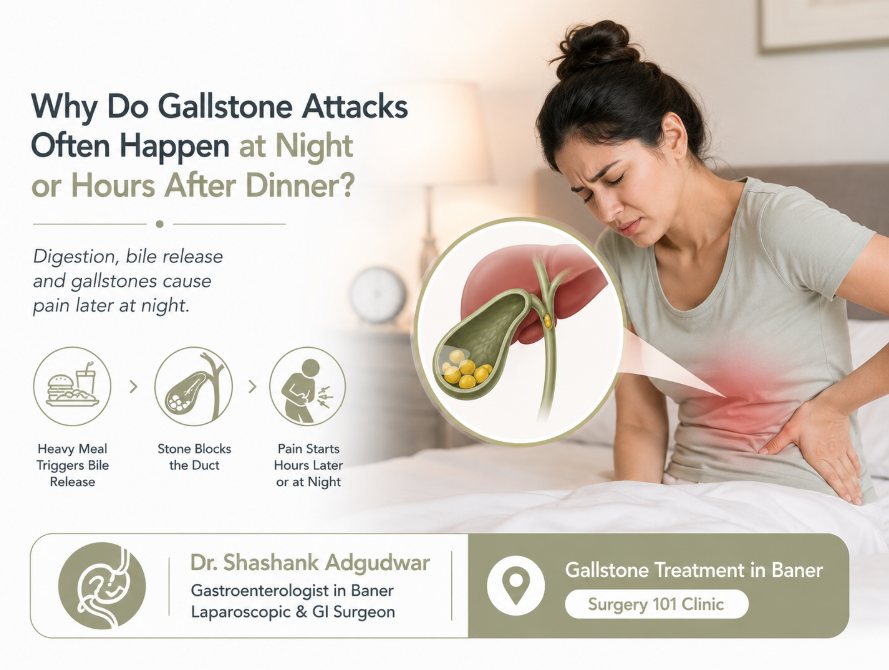
Night-Time Gallbladder Pain and Gallstone Treatment
You eat dinner, feel fine for a while and then wake later with intense pain under the right side of your ribs. The pain may last for hours and sometimes spread toward your back or right shoulder.
This pattern is commonly described during a gallbladder attack, medically called biliary colic.
The timing is not random. NIDDK specifically notes that gallbladder attacks often follow heavy meals and commonly occur during the evening or at night.
Understanding why this happens can help explain why someone may need gallstone treatment in Baner even when they feel completely normal between episodes.
What Causes a Gallbladder Attack?
The gallbladder stores bile produced by the liver.
When you eat, particularly a meal containing fat, digestive signals encourage the gallbladder to contract and release bile into the intestine.
If a gallstone temporarily obstructs the gallbladder outlet or bile duct during this contraction, pressure builds up and can produce significant pain.
Gallbladder attacks therefore often occur after meals rather than continuously throughout the day.
Why Can Pain Start Several Hours After Dinner?
Digestion does not stop as soon as you finish eating.
Gallbladder contraction and movement of bile continue as the digestive process progresses.
A stone may not obstruct the outlet immediately. It can shift position as the gallbladder contracts, creating pain later in the evening.
This explains why someone can eat dinner at 8 pm and develop significant symptoms closer to midnight.
Do Fatty Meals Trigger Gallstone Pain?
Heavy meals are recognized triggers for gallbladder attacks in people with symptomatic gallstones. NIDDK specifically notes the association between gallbladder attacks and heavy meals.
Fats stimulate gallbladder contraction because bile is required for fat digestion.
This does not mean that dietary fat created the gallstone that evening. Rather, the meal may trigger contraction of a gallbladder that already contains stones.
What Does Typical Gallstone Pain Feel Like?
Gallbladder attacks typically cause pain in the upper right abdomen, although some people experience pain in the upper central abdomen.
The pain may last for several hours.
It may also radiate toward the back or right shoulder and can be accompanied by nausea or vomiting.
People sometimes mistake the discomfort for acidity or gas, particularly during their first attack.
Why Does the Pain Eventually Stop?
With uncomplicated biliary colic, the stone may move away from the obstructed position, allowing pressure inside the gallbladder to decrease.
The pain can then settle completely.
Feeling normal the following morning does not mean the stones have disappeared.
NIDDK notes that after someone has experienced one gallbladder attack, additional attacks are likely to occur.
This is why recurrent episodes deserve evaluation.
When Is It More Than a Simple Gallbladder Attack?
Persistent obstruction can lead to inflammation of the gallbladder, called acute cholecystitis.
A stone can also enter the common bile duct and obstruct bile flow.
Seek urgent medical care for severe or persistent abdominal pain associated with fever, chills, repeated vomiting or jaundice.
Gallstones can cause serious complications when bile ducts remain blocked.
Can Gallstones Cause Pancreatitis?
Yes.
If a stone migrates through the bile duct and blocks drainage near the pancreatic duct, acute pancreatitis may develop.
Pancreatitis can cause significant upper abdominal pain, often with nausea and vomiting, and may require hospitalization.
This is one reason symptomatic gallstones should not simply be managed by repeatedly avoiding fatty meals.
Why Does Acidity Often Get Blamed?
Both acid-related conditions and gallstone disease can cause discomfort after food.
However, typical gallbladder pain tends to be more intense and is often concentrated in the upper right or central abdomen, whereas reflux commonly produces heartburn or regurgitation.
Symptoms overlap enough that self-diagnosis is unreliable.
An ultrasound and medical assessment can often help establish whether gallstones are responsible.
Does Avoiding Dinner Prevent Gallstone Attacks?
Avoiding a trigger meal may reduce the likelihood of symptoms temporarily, but it does not remove gallstones.
Some people gradually restrict more and more foods because they are frightened of provoking another painful episode.
If gallstones are repeatedly symptomatic, discussing definitive treatment is generally more useful than indefinitely avoiding normal meals.
Does Everyone With Gallstones Need Surgery?
No.
Many gallstones are discovered incidentally and never cause symptoms. NIDDK notes that silent gallstones generally do not require treatment.
The situation changes once recurrent gallbladder attacks or complications develop.
For symptomatic gallstones, removal of the gallbladder is the usual definitive treatment.
The decision should be individualized based on symptoms and overall health.
How Are Gallstones Diagnosed?
Ultrasound is commonly used to detect gallstones and evaluate the gallbladder.
Blood tests may be recommended when doctors need to look for inflammation or evidence that the liver, bile ducts or pancreas may be involved.
Additional imaging may be required if a stone in the common bile duct is suspected.
Should You Wait Until the Next Attack?
If you have already experienced repeated episodes of characteristic upper abdominal pain after meals, waiting indefinitely can mean dealing with unpredictable attacks.
A planned consultation allows your doctor to assess the gallbladder while you are well and discuss treatment options before an emergency complication develops.
Gallstone Treatment in Baner at Surgery 101 Clinic
If you repeatedly develop upper abdominal pain several hours after dinner or wake at night with suspected gallbladder attacks, consider getting evaluated.
At Surgery 101 Clinic, Dr. Shashank Adgudwar provides assessment and gallstone treatment in Baner based on symptoms, imaging and individual clinical needs.
Appropriate evaluation can help determine whether the symptoms represent gallstone disease and whether surgery or another management approach is appropriate.
Frequently Asked Questions
1. Why do my gallstones hurt mainly at night?
Gallbladder attacks often follow heavy meals and commonly occur in the evening or at night because gallbladder contraction after eating can cause a stone to obstruct bile flow.
2. How long can a gallstone attack last?
Gallbladder attack pain can last for several hours. Pain that remains severe or is accompanied by fever, jaundice or persistent vomiting requires prompt medical assessment.
3. Will avoiding fatty food cure gallstones?
No. Avoiding trigger foods may reduce attacks in some people, but it does not remove existing stones. Symptomatic gallstone disease may require definitive treatment.
#gallstonetreatmentinbaner #gallstones #gallbladderattack #gallbladderstones #gallbladderhealth #abdominalpain #gastroenterologistinbaner #surgery101clinic