
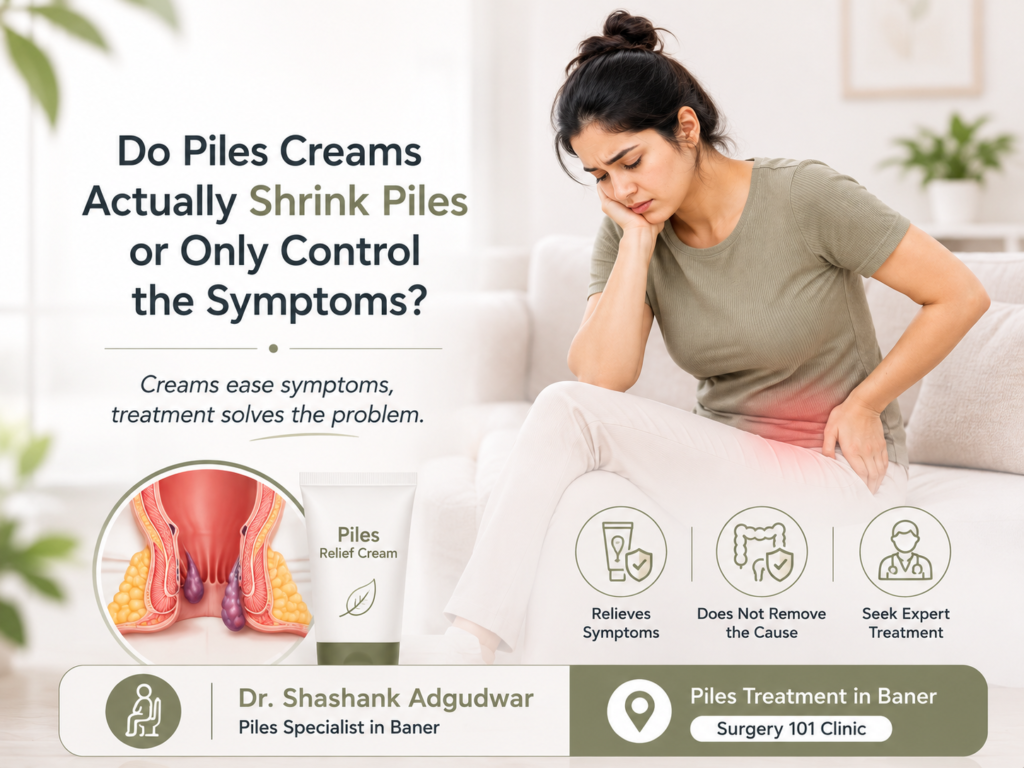
Understanding What Piles Creams Can and Cannot Do With a Piles Specialist in Baner
When piles cause itching, swelling or discomfort, buying a cream from the pharmacy often seems like the easiest solution.
After applying it for a few days, symptoms may settle. That naturally raises the question: Has the cream actually removed the piles, or has it only made them feel better?
For most over-the-counter hemorrhoid creams, the main role is symptom relief rather than permanently eliminating significant hemorrhoidal tissue.
NIDDK states that over-the-counter hemorrhoid creams, ointments and suppositories may relieve mild pain, swelling and itching associated with external hemorrhoids. It also advises medical review if symptoms do not improve after about a week of such treatment.
Understanding this distinction helps you know when home treatment is reasonable and when a Piles specialist in Baner should evaluate persistent symptoms.
What Are Piles?
Piles, medically called hemorrhoids, involve enlarged or swollen tissues and blood vessels around the anus and lower rectum.
They can be internal or external.
Internal hemorrhoids may cause painless bright red bleeding or tissue that protrudes during bowel movements. External hemorrhoids may cause swelling, itching or pain.
The right treatment depends partly on which type is present and how severe the symptoms are.
What Do Piles Creams Actually Do?
Different creams contain different ingredients.
Some are designed to reduce irritation or itching. Others may temporarily reduce swelling or numb the area to improve comfort.
NIDDK recognizes these products as short-term options for relieving mild hemorrhoid symptoms.
That does not mean the cream corrects the structural reason the hemorrhoid developed or prevents it from recurring.
Can a Cream Permanently Shrink Large Piles?
Usually not.
Significant internal hemorrhoids, particularly those that repeatedly prolapse outside the anus, are unlikely to disappear permanently because a topical cream was applied externally.
Creams may make symptoms less noticeable while the hemorrhoidal tissue itself remains.
If bleeding or prolapse repeatedly returns as soon as medication is stopped, the underlying piles may require assessment.
Why Do Advertisements Claim That Creams Shrink Piles?
Some ingredients can temporarily reduce swelling or inflammation.
This may make an external hemorrhoid feel smaller for a period of time.
Temporary improvement should not be confused with definitive treatment.
The most useful question is whether the symptoms remain controlled after the cream is stopped and whether bleeding or prolapse is continuing.
How Long Should You Use an Over-the-Counter Cream?
NIDDK advises that doctors most often recommend over-the-counter hemorrhoid products for about one week and that patients should seek medical advice if symptoms fail to improve or the product causes skin problems.
Long-term unsupervised use is not automatically safer because the product is available without a prescription.
Some preparations can irritate the sensitive skin around the anus when used repeatedly.
Why Does Constipation Matter More Than Cream?
Constipation and repeated straining can continue increasing pressure around hemorrhoidal tissues.
If these factors remain unchanged, symptom-relieving cream alone does little to address why piles keep becoming irritated.
NIDDK recommends measures such as increasing dietary fiber, avoiding straining and reducing prolonged toilet sitting as part of hemorrhoid management.
For long-term management, improving bowel habits may therefore be more important than repeatedly buying different creams.
Can Fiber Actually Help Piles?
Yes.
Fiber makes stool easier to pass and can help both treat and prevent hemorrhoid-related problems, according to NIDDK.
Fruits, vegetables, legumes and whole grains are common dietary sources.
Some people may benefit from a fiber supplement when appropriate.
Fiber intake should usually be increased gradually to reduce bloating, and adequate fluid intake is also important according to individual medical needs.
What If the Bleeding Is Not From Piles?
This is one of the biggest risks of repeatedly self-treating rectal bleeding.
Hemorrhoids are a common cause of bright red bleeding, but they are not the only one. Gastrointestinal bleeding can have several possible causes.
Anal fissures, inflammation and other bowel conditions can sometimes produce similar symptoms.
If bleeding repeatedly returns, getting an examination is safer than assuming every episode is piles.
What If You Have Severe Pain?
Uncomplicated internal hemorrhoids often cause bleeding rather than intense pain.
Severe pain can occur with certain external hemorrhoid problems, but conditions such as an anal fissure or abscess can also be painful.
This is another situation where simply adding more cream may delay the correct diagnosis.
When Do Piles Need a Procedure?
Not every hemorrhoid requires surgery.
Treatment depends on symptoms and severity.
When conservative measures do not adequately control significant bleeding or prolapse, doctors may consider office-based procedures or surgical options.
The most appropriate treatment depends on hemorrhoid type and grade as well as the patient’s health and preferences.
Can Laser Treatment Be Used for Piles?
Selected patients may be offered laser-based or other minimally invasive approaches.
However, the word “laser” does not automatically mean it is the best procedure for every hemorrhoid.
A piles specialist should first determine the type and severity of disease and whether another procedure would be more appropriate.
No procedure also eliminates the need for good bowel habits afterward.
When Should You Stop Self-Treating?
See a doctor if symptoms repeatedly return after stopping creams, bleeding continues, tissue comes out during bowel movements or pain is significant.
NIDDK specifically advises follow-up when OTC hemorrhoid products fail to relieve symptoms within approximately one week.
Prompt medical attention is appropriate for heavy bleeding, faintness, severe pain with fever or black stools.
Cream Can Calm Symptoms Without Fixing the Cause
Piles creams have a legitimate role for short-term relief.
The problem begins when months of recurring bleeding, prolapse or discomfort are repeatedly managed with temporary creams instead of assessing the hemorrhoids themselves.
Managing constipation and toilet habits is also essential because treatment is more than simply reducing today’s swelling.
Consult Dr. Shashank Adgudwar, Piles Specialist in Baner
If piles symptoms repeatedly return whenever you stop using creams, consider having the condition properly assessed.
At Surgery 101 Clinic, Dr. Shashank Adgudwar, Piles specialist in Baner, provides evaluation and individualized management for hemorrhoids and related anorectal conditions.
Appropriate assessment can help determine whether conservative treatment is enough or whether another treatment option should be considered.
Frequently Asked Questions
1. Can piles cream completely cure piles?
Most over-the-counter creams mainly relieve symptoms such as mild pain, itching and swelling. They do not necessarily permanently eliminate significant hemorrhoidal tissue.
2. How long should I use Pile’s Cream?
NIDDK notes that doctors commonly recommend OTC hemorrhoid preparations for around one week. Persistent symptoms should be medically evaluated.
3. Why do piles come back after the cream works?
The cream may temporarily control inflammation while underlying hemorrhoidal tissue and contributing factors such as constipation or straining remain.
#pilesspecialistinbaner #piles #hemorrhoids #pilestreatment #constipation #rectalbleeding #bowelhealth #gastroenterologistinbaner #surgery101clinic