
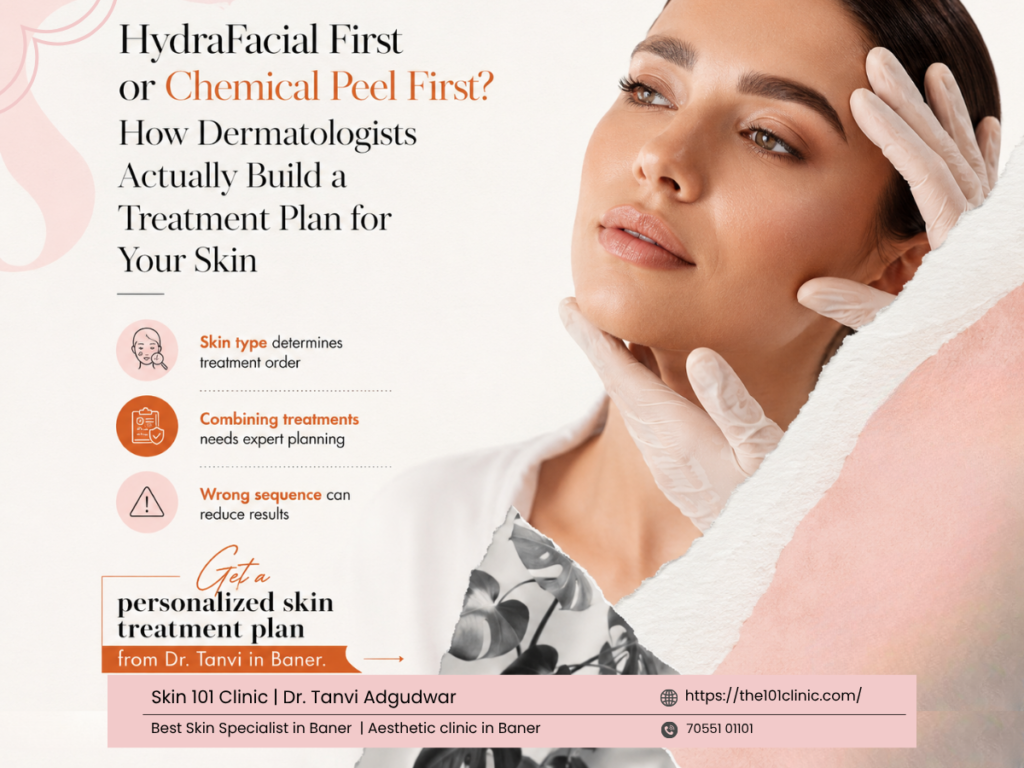
Choosing Hydrafacial in Baner Based on Your Skin’s Actual Needs
Written by: Skin 101 Clinic Editorial Team
Medically reviewed by: Dr. Tanvi Komawar Adgudwar, Dermatologist and Hair Specialist
Last reviewed: 31 July 2026
HydraFacials and chemical peels are both popular treatments for improving dullness, congestion, pigmentation and uneven skin texture. However, choosing between them should not be based only on popularity or social media trends.
The honest answer is that there is no fixed treatment order that works for everyone. A dermatologist first considers your skin type, main concern, sensitivity, medical history, current skincare routine and expected results.
Some people benefit from starting with HydraFacial, while others need a carefully selected chemical peel first. If the skin barrier is already irritated or inflamed, both procedures may need to be postponed.
People searching for Hydrafacial in Baner should therefore begin with a proper skin assessment rather than selecting a standard facial package without understanding what their skin needs.
The Quick Answer
A dermatologist may recommend:
- HydraFacial first for mild congestion, blackheads, dehydration, surface buildup and temporary dullness
- Chemical peel first for concerns such as acne, post acne marks, melasma, sun damage or uneven texture
- Neither treatment immediately if there is active irritation, sunburn, infection, an eczema flare, severe sensitivity or a damaged skin barrier
The correct starting point depends on the condition of your skin on the day of the consultation, not simply on which treatment is considered gentler.
How HydraFacial Works
HydraFacial is a form of hydradermabrasion that combines cleansing, controlled exfoliation, suction based extraction and the application of hydrating serums. It is commonly selected for dullness, mild congestion, blackheads, dehydration and rough surface texture.
Although it is often described as a gentle facial, HydraFacial still exfoliates the skin. Some customised protocols also include mild acids. The treatment therefore needs to be adjusted for people with sensitive, reactive or recently treated skin.
A small clinical study involving 20 women found that hydradermabrasion performed with an antioxidant serum improved the appearance of fine lines, pore size and hyperpigmentation. However, this was a small study, so the findings should be considered promising rather than conclusive for every skin condition. The research was published in the Journal of Cosmetic Dermatology and indexed by PubMed.
HydraFacial may help improve the appearance of the skin, but it should not be presented as a cure for severe acne, deep scars, melasma or permanently enlarged pores. These concerns usually require a more comprehensive dermatological plan.
How a Chemical Peel Works
A chemical peel involves applying a carefully selected chemical solution to create controlled exfoliation at a specific skin depth. Peels may be classified as superficial, medium or deep, depending on how far the peeling agent penetrates.
Chemical peels may be considered for:
- Active acne and oily skin
- Post acne pigmentation
- Melasma and uneven skin tone
- Fine lines and sun damaged skin
- Mild textural irregularities and superficial scars
According to the National Library of Medicine, the effect of a chemical peel depends on the peeling agent, concentration, pH, contact time, application technique and the patient’s skin condition.
This is why two people with similar looking pigmentation may require completely different peel strengths or treatment schedules. The name of the peel alone does not determine whether it is suitable or safe.
How Dermatologists Build a Personalised Treatment Plan
Before recommending either treatment, a dermatologist normally assesses several factors.
1. The primary skin concern
The treatment should address the condition that matters most. HydraFacial may be helpful when dehydration and congestion are the main concerns. A chemical peel may be considered when acne, pigmentation or uneven texture requires more targeted exfoliation.
2. Skin barrier health
A healthy skin barrier helps the skin tolerate cosmetic procedures. Persistent burning, flaking, redness or sensitivity may indicate that the barrier needs to be repaired before treatment.
3. Skin type and pigmentation risk
People with Indian and other darker skin tones may be more likely to develop post inflammatory hyperpigmentation after excessive irritation. This does not mean chemical peels cannot be performed. It means peel selection, preparation and aftercare require greater care.
A review published in the Journal of Clinical and Aesthetic Dermatology found that chemical peels can be performed safely in skin of colour when suitable precautions are followed. Superficial peels, careful patient selection and appropriate skin preparation may help reduce complications.
4. Medicines and skincare products
Retinoids, acne medicines, exfoliating acids, antibiotics and some other treatments can influence skin sensitivity. A dermatologist should also know about previous cosmetic procedures, a history of cold sores and any tendency to develop abnormal scars.
The American Academy of Dermatology recommends sharing this information before undergoing a chemical peel. Some patients may require a preparation routine for two to four weeks before treatment.
5. Downtime and upcoming events
A patient seeking an immediate refreshed appearance before an event may have different requirements from someone beginning a long term acne or pigmentation programme.
Superficial peels may cause temporary redness, dryness and flaking. Medium and deep peels require significantly more recovery time and medical supervision.

Expert Perspective from Dr. Tanvi Komawar Adgudwar
In dermatological treatment planning, the condition of the skin barrier is often more important than the patient’s preferred procedure. Treating inflamed, sensitive or over exfoliated skin too aggressively can increase irritation and delay visible improvement.
Dr. Tanvi Komawar Adgudwar’s treatment planning approach begins with identifying the skin concern and assessing whether the skin is ready for a procedure. If the barrier appears compromised, the immediate priority may be gentle skincare and barrier repair. HydraFacial or a chemical peel can then be reconsidered once the skin is stable.
This step is important because a successful treatment plan is not about performing the maximum number of procedures. It is about choosing the right procedure, strength and timing for the individual patient.
When HydraFacial May Be Recommended First
HydraFacial may be selected first when the skin is generally healthy but appears dull, dehydrated or mildly congested. Removing surface buildup and extracting suitable clogged pores can create a cleaner and more hydrated starting point.
It may also be considered when someone wants a refreshed appearance with minimal disruption to their routine. However, aggressive extraction should be avoided over painful or inflamed acne lesions.
After the first session, the dermatologist can evaluate how the skin responds. If pigmentation, acne or uneven texture remains the main concern, a chemical peel or another dermatological treatment may be planned later.
When a Chemical Peel May Be Recommended First
A chemical peel may come first when the main concern is active acne, post acne pigmentation, melasma, sun damage or uneven texture and the skin barrier is ready for controlled exfoliation.
The peeling agent is selected according to the concern and skin type. Salicylic acid may be considered for oily and acne prone skin, while glycolic, lactic or mandelic acid may be selected for other concerns.
Peel strength, contact time and frequency should be decided by a trained professional. Stronger does not automatically mean better. Excessive exfoliation may cause prolonged redness, burns, infection, pigment changes or scarring.
The US Food and Drug Administration warns against using high concentration chemical peel products without professional supervision because of the risk of serious skin injuries.
Can HydraFacial and a Chemical Peel Be Combined?
Both treatments may be included in the same overall skincare plan, but they should not automatically be performed during the same appointment.
HydraFacial already involves exfoliation and may include a mild acid step. Adding a stronger chemical peel without considering the total exfoliation level may increase dryness, burning, redness and pigment changes.
A dermatologist may separate the procedures and wait until the skin has returned to its normal condition. The correct interval depends on skin sensitivity, peel depth, treatment response and the active ingredients being used at home.
The American Academy of Dermatology notes that superficial peels may require three to five sessions and can be repeated every two to five weeks. This should not be treated as a fixed schedule for combining HydraFacial with chemical peels. Individual assessment remains essential.
What a Safe Treatment Plan Should Include
- An accurate skin assessment: Acne, rosacea, melasma and irritation may sometimes appear similar but require different treatment approaches.
- Realistic expectations: HydraFacial and chemical peels can improve selected concerns, but results vary and multiple sessions may be required.
- Gradual treatment: Starting with one carefully selected procedure makes it easier to understand how the skin responds.
- Suitable home care: Gentle cleansing, appropriate moisturisation and regular sunscreen use are important before and after treatment.
- Follow up: Persistent redness, burning, swelling, blistering or unusual pigmentation should be reported to the treating dermatologist.
Read More –
- HydraFacial vs. Regular Clean-Up: Why Results Look So Different
- Why Hydration Is Key for Good Digestive Health
- The Benefits of HydraFacial: Achieve Radiant Skin with Dr. Tanvi Komawar at The 101 Clinic
Personalised Treatment Planning at Skin 101 Clinic
For patients considering Hydrafacial in Baner, Skin 101 Clinic provides individual skin assessments under the guidance of Dr. Tanvi Komawar Adgudwar. The consultation considers skin type, sensitivity, medical history, current products and the concern the patient wants to address.
Depending on the assessment, Dr. Tanvi may recommend HydraFacial, a suitable chemical peel, medical skincare or another dermatological treatment. The goal is to create a safe and realistic plan while protecting the skin barrier and minimising unnecessary irritation.
Frequently Asked Questions
1. Can HydraFacial and a chemical peel be performed on the same day?
A mild acid step may sometimes be included within a customised HydraFacial. However, combining HydraFacial with a separate chemical peel during the same appointment is not suitable for everyone. The decision depends on the acid strength, skin sensitivity, treatment history and current barrier health. It should only be planned by a qualified dermatologist or trained professional.
2. Is HydraFacial or a chemical peel better for acne and acne scars?
HydraFacial may help with surface congestion, selected blackheads and excess oil. Chemical peels may be more appropriate for certain types of acne, post acne pigmentation and mild textural irregularities. Neither treatment can remove every type of acne scar. Deep or indented scars may require treatments such as microneedling, subcision, laser procedures or a combination plan after active acne is controlled.
3. How long should I wait between HydraFacial and a chemical peel?
There is no universal waiting period. The skin should be free from persistent redness, peeling, burning and unusual sensitivity before another exfoliating procedure is performed. A dermatologist will recommend the interval based on the peel depth, treatment response and products used in the patient’s skincare routine.
Medical Disclaimer
This article is intended for general educational purposes only. It does not provide a diagnosis or replace an individual consultation with a qualified dermatologist. Treatment suitability, results, risks and recovery time vary according to skin type, medical history and the procedure performed.
#hydrafacial #chemicalpeel #skincareplan #dermatologistinbaner #skin101clinic #acnetreatment #skinhealth