
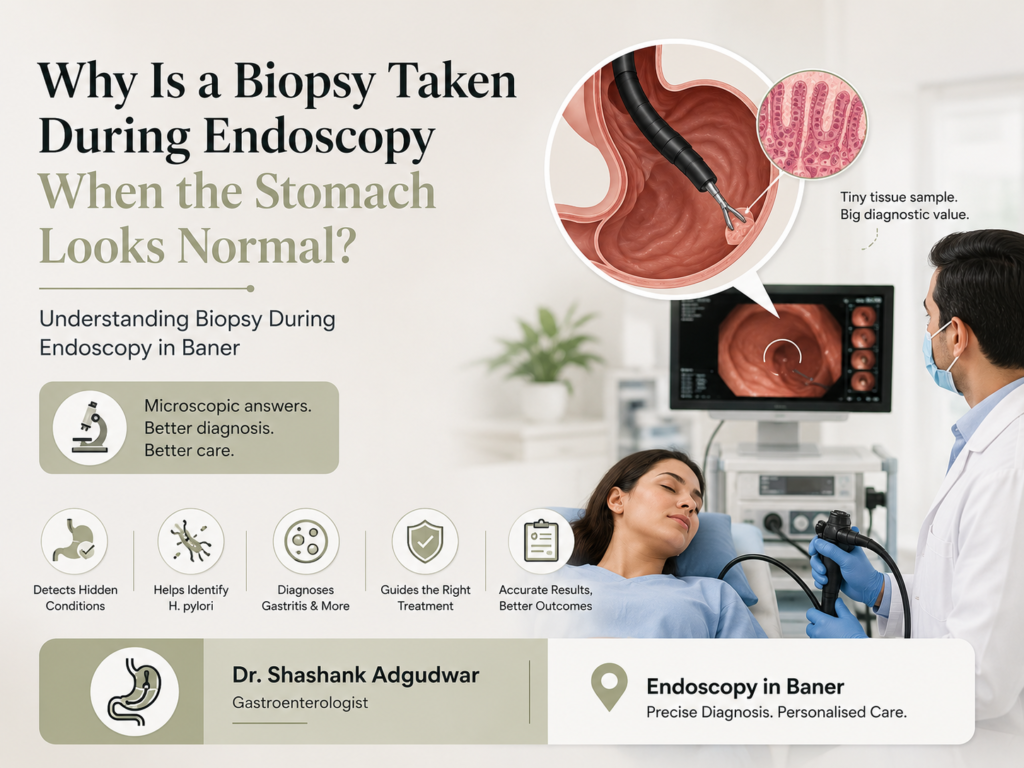
Understanding Biopsy During Endoscopy in Baner
You undergo an endoscopy because of persistent acidity, abdominal discomfort, anemia or another digestive complaint. After the procedure, the doctor tells you that the stomach looked normal but that a few tiny tissue samples were still taken for biopsy.
Naturally, this can sound worrying.
Many patients associate the word “biopsy” with cancer. But during gastrointestinal endoscopy, biopsies are taken for many reasons that have nothing to do with suspected cancer.
Some digestive conditions produce microscopic changes that cannot be reliably identified just by looking at the surface of the stomach or intestine.
Therefore, during Endoscopy in Baner, a gastroenterologist may take small tissue samples even when the lining appears normal to the naked eye.
What Happens During an Upper GI Endoscopy?
Upper gastrointestinal endoscopy is a procedure that allows a doctor to examine the inside of the oesophagus, stomach and first part of the small intestine using a thin flexible instrument called an endoscope.
The American Society for Gastrointestinal Endoscopy, or ASGE, defines an endoscope as a flexible tube equipped with light and a lens that allows doctors to examine structures including the oesophagus, stomach and duodenum.
During the procedure, the doctor can identify visible abnormalities such as inflammation, ulcers, narrowing, polyps or masses.
Tiny instruments can also be passed through the endoscope to collect tissue samples.
Why Can Something Be Abnormal Microscopically but Look Normal?
Endoscopy shows the surface appearance of the digestive lining.
A biopsy lets a pathologist examine individual cells and tissue architecture under a microscope.
The two methods answer different questions.
For example, early or subtle inflammation may not create an obvious visible change. Certain infections or immune-mediated disorders may also require microscopic assessment.
This is why a normal-looking endoscopy does not always mean that tissue sampling has no value.
Does Taking a Biopsy Mean the Doctor Suspects Cancer?
No.
This is one of the most common concerns patients have after an endoscopy.
Biopsies are certainly used to investigate suspicious ulcers, growths and other lesions, but cancer evaluation is only one reason for taking tissue.
ASGE guidance on gastrointestinal tissue sampling discusses biopsy protocols for conditions including Helicobacter pylori infection, gastritis and other mucosal disorders, as well as sampling of visible lesions when appropriate.
Therefore, hearing that a biopsy was taken should not automatically be interpreted as a sign that cancer was seen.
Why Is a Biopsy Taken for H. pylori?
Helicobacter pylori, commonly called H. pylori, is a bacterium that can infect the stomach lining.
It is associated with chronic gastritis and peptic ulcer disease and is clinically important because persistent infection can cause long-term changes in the stomach.
During endoscopy, gastric tissue can sometimes be tested for H. pylori.
ASGE guidance specifically recognizes gastric biopsy as one method of assessing H. pylori infection.
Whether biopsy testing is needed depends on why the endoscopy is being performed and what other tests have already been done.
Can Gastritis Be Present When the Stomach Looks Normal?
Yes, in selected cases.
Gastritis technically refers to inflammation identified within the stomach lining. Some microscopic inflammatory changes may be subtle or not obvious during routine visual inspection.
Certain conditions are fundamentally histological diagnoses, meaning they are established by examining tissue.
For example, ASGE’s summary of clinical guidance on atrophic gastritis notes that atrophic gastritis is confirmed histologically by demonstrating loss of gastric glands.
This demonstrates why visual appearance and microscopic findings are not always identical.
Why Might a Biopsy Be Taken From the Small Intestine?
During an upper endoscopy, the doctor can also examine the duodenum, which is the first part of the small intestine.
In selected patients, small intestinal biopsies may be taken when conditions such as celiac disease are being considered.
Whether these samples are necessary depends on symptoms, blood-test results and clinical suspicion.
They are not routinely required for every person undergoing endoscopy.
What Symptoms Might Lead to Biopsy?
The reason for taking biopsy samples depends on the patient.
Examples can include:
- Persistent upper abdominal symptoms that remain unexplained
- Unexplained iron-deficiency anemia in an appropriate clinical setting
- Suspicion of H. pylori-related disease
- Concern about malabsorption or celiac disease
- Abnormal or suspicious tissue seen during endoscopy
Biopsies are therefore targeted according to the clinical question rather than taken simply because an endoscope is being performed.
Does the Biopsy Hurt?
The inner lining of the stomach and intestine does not perceive a tiny endoscopic biopsy in the same way skin would perceive being cut.
Patients generally do not feel each small tissue sample being taken during the procedure.
The endoscopy itself may be performed with throat anaesthesia, sedation or another approach depending on the patient and facility.
Your doctor can explain what to expect before your procedure.
How Big Is an Endoscopy Biopsy?
Endoscopic biopsies are very small tissue samples.
Special forceps are passed through a channel within the endoscope to collect the tissue.
Several samples may sometimes be taken from different areas because certain microscopic conditions are not distributed uniformly.
The samples are sent to a pathology laboratory, where they are processed and examined under a microscope.
Why Take More Than One Sample?
A condition may affect one part of the stomach more than another.
Taking samples from carefully selected sites can improve the amount of diagnostic information available.
For some gastrointestinal diseases, guidelines specify particular biopsy locations because disease distribution matters.
This is different from randomly removing tissue.
A gastroenterologist chooses biopsy sites according to the suspected condition, endoscopic findings and accepted clinical protocols.
What Does the Pathologist Look For?
The exact assessment depends on why the biopsy was requested.
A pathologist may look for inflammation, H. pylori-related changes, tissue atrophy, intestinal metaplasia, abnormal immune patterns or cellular changes.
When a visible lesion has been sampled, pathology helps establish precisely what type of tissue it represents.
The pathology report is then interpreted together with your symptoms and endoscopy findings.
What If Both the Endoscopy and Biopsy Are Normal?
A normal endoscopy and normal biopsy can still provide useful information.
It may help rule out several structural or microscopic conditions and allow your gastroenterologist to consider functional digestive disorders or other causes of your symptoms.
For example, some people with persistent upper abdominal discomfort may have symptoms despite no major structural abnormality being identified at endoscopy.
A normal test therefore does not mean your symptoms are imaginary. It helps narrow the diagnostic possibilities.
Is Biopsy Necessary During Every Endoscopy?
No.
Biopsy is not automatically required during every upper GI endoscopy.
Your doctor considers your symptoms, age, previous investigations, visible findings and clinical question before deciding whether tissue sampling is useful.
Similarly, biopsies should not be performed simply as a routine habit when they are unlikely to change diagnosis or management.
Professional guidelines emphasize appropriate, indication-based tissue sampling.
Should You Be Worried While Waiting for a Biopsy Report?
The word biopsy understandably creates anxiety.
Remember that samples are frequently taken to evaluate inflammation, infection and other non-cancerous disorders.
The reason for your biopsy should ideally be explained by your gastroenterologist after the endoscopy.
Rather than interpreting the biopsy itself as a warning sign, wait for the pathology result and discuss its meaning in the context of the endoscopy findings.
Endoscopy in Baner at Surgery 101 Clinic
If persistent acidity, abdominal pain, swallowing difficulty or another digestive symptom requires further evaluation, upper gastrointestinal endoscopy may help identify the cause.
At Surgery 101 Clinic, Dr. Shashank Adgudwar provides endoscopy in Baner and evaluation of upper gastrointestinal conditions based on individual clinical requirements.
When a biopsy is appropriate, tissue findings can provide information that may not be visible during the procedure itself and help guide further treatment.
Frequently Asked Questions
1. Why did my doctor take a biopsy if my endoscopy was normal?
Some digestive conditions cause microscopic changes that are difficult or impossible to identify by visual inspection alone. Biopsy allows a pathologist to examine the tissue in much greater detail.
2. Does a stomach biopsy always test for cancer?
No. Endoscopic biopsies are commonly used to evaluate H. pylori, gastritis and other inflammatory or microscopic conditions. They are also used to assess suspicious lesions when necessary.
3. Is a biopsy during endoscopy painful?
Patients generally do not feel individual biopsy samples being taken from the stomach or intestinal lining. The overall comfort of an endoscopy depends on factors such as throat anaesthesia, sedation and individual tolerance.
#endoscopy #endoscopyinbaner #stomachbiopsy #gastroscopy #hpylori #digestivehealth #gastroenterologistinbaner #gastritis #surgery101clinic