
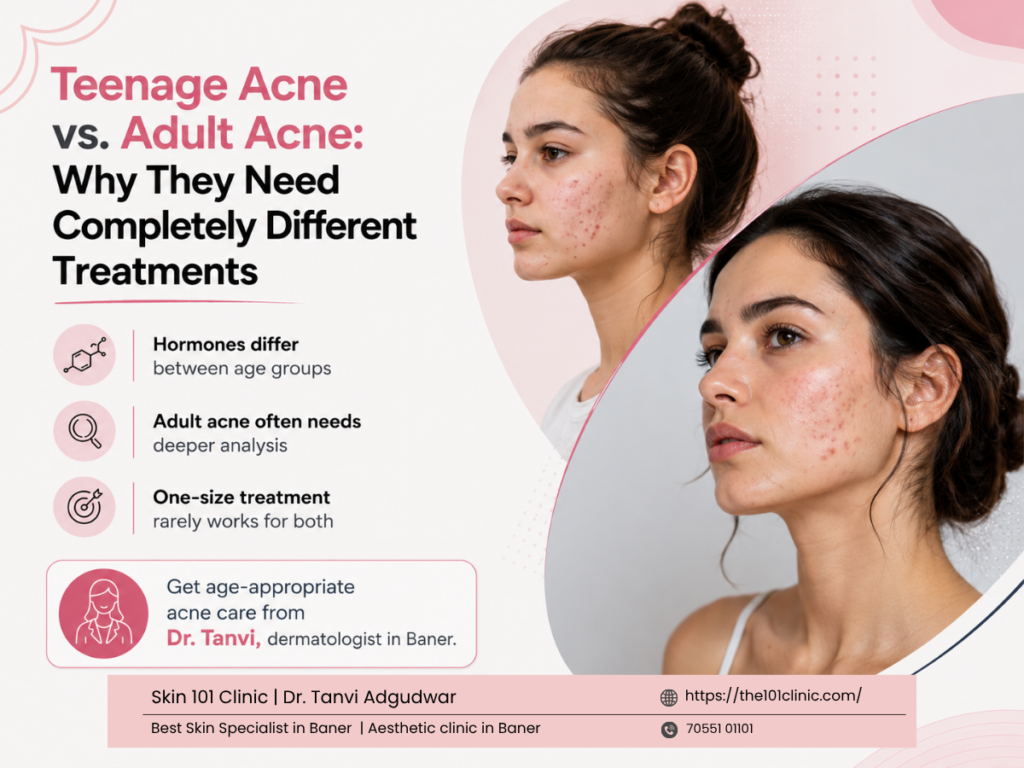
If you have ever felt frustrated that the acne cream which cleared your skin at seventeen does absolutely nothing for you at thirty, you are not imagining things. Acne is not one single condition with one universal fix. It shows up differently depending on your age, your hormones, and even your lifestyle, which means the same face wash or spot gel that worked for your teenage self may be completely useless for the breakouts you are dealing with now.
As a practicing dermatologist, one of the most common misconceptions I encounter is patients assuming that acne is acne, regardless of when it appears. In reality, teenage acne and adult acne are driven by different mechanisms, appear in different areas of the face, and respond to different treatment approaches. Understanding this distinction is the first step toward effective acne and scar treatment.
Why Teenage Acne Happens
Teenage acne, sometimes called adolescent acne, typically begins around puberty when the body experiences a surge in androgen hormones. This is a near-universal experience. Research published in the Journal of the American Academy of Dermatology found that acne prevalence among people aged 15 to 24 in several European countries touched nearly 58 percent, making it one of the most common skin conditions in this age group.
Here is what typically drives breakouts during the teenage years:
- Hormonal surges: Rising androgens stimulate the sebaceous glands to produce more oil than the skin actually needs.
- Excess sebum production: This oil, combined with dead skin cells, clogs pores and creates the perfect environment for acne-causing bacteria.
- T-zone concentration: Teenage acne usually clusters on the forehead, nose, and chin, areas with the highest concentration of oil glands.
- Rapid, visible flare-ups: Breakouts tend to appear and resolve relatively quickly, though they can still leave marks if picked at or treated harshly.
Because the root cause is largely hormonal and oil-driven, teenage acne generally responds well to treatments that control oil production and unclog pores, such as topical retinoids, benzoyl peroxide, and salicylic acid based cleansers.
Why Adult Acne Is a Different Story
Adult acne, especially in women, has become increasingly common and is often more stubborn than the teenage version. According to data highlighted by the American Academy of Dermatology, a clinical study tracking women across different age groups found that 45 percent of women aged 21 to 30 had visible acne, with the number gradually declining but not disappearing in later decades. Separately, a large-scale retrospective study by researchers at Yale School of Medicine found that after age 20, acne accounted for an almost two and a half times higher proportion of dermatology visits among women compared to men.
Adult acne tends to look and behave differently from its teenage counterpart:
- Hormonal fluctuations, not surges: Adult acne is often linked to menstrual cycles, pregnancy, perimenopause, polycystic ovary syndrome, or stopping birth control, rather than the steady hormonal rise seen in puberty.
- Jawline and chin distribution: Unlike the T-zone pattern of teenage acne, adult breakouts frequently appear along the jawline, chin, and lower cheeks. A clinical review in the journal Clinical Dermatology noted that adult acne is predominantly inflammatory in nature and tends to favor the cheeks, mandible, and chin.
- Slower healing, deeper lesions: Adult skin has already slowed its natural cell turnover, so breakouts often sit deeper, take longer to heal, and are more likely to leave post-inflammatory marks or scars.
- Added triggers: Chronic stress, disrupted sleep, certain cosmetics, and underlying conditions like insulin resistance can all aggravate adult acne in ways that are less relevant to teenage skin.
- Higher scarring risk: Because adult skin heals more slowly and adult acne tends to be deeper and more inflammatory, the same MDacne research summary noted earlier found that roughly 15 percent of people with acne go on to develop scarring, a risk that climbs when persistent adult acne is left untreated.
This is precisely why a proper acne and scar treatment plan for an adult needs to look beyond simple oil control. It usually requires addressing hormonal imbalance, barrier repair, and pigmentation or scarring left behind by years of breakouts.
Why One-Size-Fits-All Treatment Fails
Using a teenage acne routine on adult skin, or vice versa, often backfires. Here is why the approach genuinely needs to be tailored:
- Teenage skin is usually more resilient and can tolerate stronger exfoliants and oil-control ingredients without much irritation.
- Adult skin is often already dealing with early signs of sensitivity, dryness at the edges, or fine lines, so harsh acne treatments can damage the skin barrier further.
- Adult acne frequently requires investigating internal factors like hormones, thyroid function, or stress levels, something a teenage acne routine rarely accounts for.
- Scarring management differs too. Teenage acne scars are often shallower and may respond to consistent skincare and time, while adult acne scars, especially if breakouts have persisted for years, often need clinical interventions like chemical peels, microneedling, or laser resurfacing for real improvement.
This is also why self-treating with over-the-counter products for months, without seeing meaningful results, is such a common and frustrating experience. Acne is a medical condition with multiple underlying causes, and it genuinely benefits from a professional diagnosis rather than trial and error.
Getting the Right Diagnosis Matters More Than the Right Product
The most effective acne and scar treatment is never about finding a miracle product. It is about identifying what is actually driving your breakouts, whether that is genetics, hormones, stress, or skin barrier damage, and building a plan around that specific cause. This is where a qualified dermatologist makes all the difference, since acne that looks similar on the surface can have very different root causes underneath.
Read More –
- Why Acne Returns in the Same Areas Even After Treatment
- Hormonal & Adult Acne: Causes, Myths and How to Manage It
- 5 Hidden Causes of Acne You Didn’t Know About
How Skin 101 Clinic Can Help
If you are in Pune and have been struggling with breakouts that just will not budge or acne scars that have lingered for years, it may be time to speak with a specialist rather than continue guessing. At Skin 101 Clinic, led by Dr. Tanvi Komawar Adgudwar, patients receive a proper skin assessment before any treatment is recommended, because teenage acne and adult acne genuinely deserve different care plans.
Skin 101 Clinic offers personalized acne and scar treatment in Baner, combining clinically backed procedures like chemical peels, medi-facials, and advanced scar resurfacing with guidance on the right skincare routine for your skin type and age. Whether you are a teenager dealing with your first breakouts or an adult managing hormonal acne and old scars, working with a trusted skin specialist in Baner like Dr. Tanvi Komawar Adgudwar can help you finally get answers and results instead of another round of guesswork.
If your acne story does not seem to match the generic advice you keep finding online, that is usually a sign you need a diagnosis, not another product. Book a consultation with Skin 101 Clinic and get a treatment plan built around your skin.
Frequently Asked Questions
- What is the main difference between teenage acne and adult acne? Teenage acne is mainly driven by hormonal surges during puberty that increase oil production, and it usually appears on the forehead, nose, and chin. Adult acne is more often linked to hormonal fluctuations, stress, or underlying conditions like PCOS, and it typically shows up along the jawline and chin. Because the causes differ, effective acne and scar treatment needs to be tailored to the specific age group and trigger.
- Can adult acne be cured completely? Adult acne can be effectively managed and significantly reduced with the right combination of medical treatment, skincare, and lifestyle changes, though it may require ongoing maintenance since hormonal and stress-related triggers can recur. A dermatologist can help identify the underlying cause and create a long-term management plan rather than a one-time fix.
- Why do adult acne breakouts leave more scars than teenage acne? Adult skin has slower cell turnover and adult acne tends to be deeper and more inflammatory, which increases the likelihood of lasting marks or scars. This is why adults often need clinical procedures such as chemical peels, microneedling, or laser treatment as part of their acne and scar treatment, rather than relying on skincare alone.
#AcneTreatment #SkinCare #AdultAcne #TeenageAcne #AcneScars #SkinSpecialist #Dermatology #SkinHealth #BanerPune #Skin101Clinic