
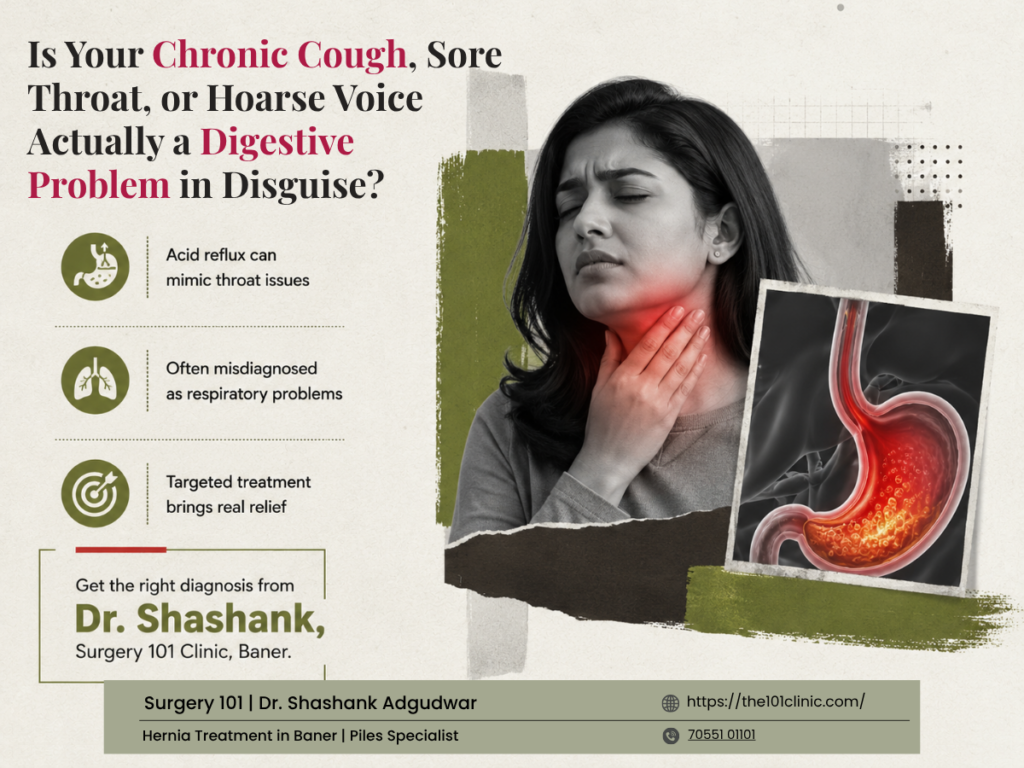
When should you see a gastroenterologist in Baner for persistent throat symptoms?
Written for: Surgery 101 Clinic
Prepared for medical review by: Dr. Shashank Adgudwar, Laparoscopic and Gastrointestinal Surgeon
Last updated: 31 July 2026
A cough that continues after a cold, a sore throat that keeps returning or a voice that becomes hoarse every morning may seem like an allergy or respiratory problem. Sometimes that is exactly what it is. However, persistent throat symptoms can also be associated with gastroesophageal reflux disease, commonly called GERD.
Reflux does not always cause obvious heartburn. In some people, stomach contents move upwards and affect the food pipe, throat or voice box. This pattern is often called extraesophageal reflux or laryngopharyngeal reflux.
If you are searching for a gastroenterologist in Baner because cough medicines and throat remedies are not helping, it may be worth considering whether a digestive condition is contributing to the problem. However, reflux should not be assumed without checking other possible causes.
How Can a Digestive Problem Affect Your Throat and Voice?
The lower oesophageal sphincter normally helps prevent stomach contents from moving back into the food pipe. When this muscle becomes weak or relaxes at the wrong time, reflux can occur.
Researchers have proposed two main ways reflux may contribute to coughing and throat symptoms. Refluxed material may directly irritate sensitive tissues in the throat, or reflux in the oesophagus may stimulate nerve pathways that increase the cough reflex.
The National Institute of Diabetes and Digestive and Kidney Diseases confirms that not everyone with GERD experiences heartburn or regurgitation. Chronic cough and hoarseness can occur as symptoms involving the throat or lungs.
This does not mean every chronic cough is caused by reflux. The American College of Gastroenterology’s GERD guideline explains that hoarseness, throat clearing and chronic cough may be associated with GERD, but these symptoms can also have many unrelated causes.
Symptoms That May Suggest Reflux Is Contributing
Certain patterns may make a digestive connection more likely:
- Coughing that becomes worse after meals or while lying down
- Morning hoarseness, repeated throat clearing or a sensation of something stuck in the throat
- A sour taste, burning sensation, burping or food coming back into the mouth
- Symptoms that worsen after late meals, large portions or personally identified trigger foods
- A dry cough that continues without an obvious respiratory infection
These patterns are clues, not a diagnosis. Asthma, allergies, sinus drainage, smoking, infections, voice overuse and certain blood pressure medicines can produce similar symptoms.
A cough lasting more than eight weeks in an adult is generally considered chronic. The CHEST Guideline and Expert Panel Report recommends an organised evaluation that first considers the common causes of chronic cough instead of immediately treating every patient for reflux.
Why “Silent Reflux” Can Be Difficult to Diagnose
The term silent reflux is often used when throat symptoms occur without typical heartburn. However, symptoms alone cannot reliably prove that reflux is the cause.
Even redness or irritation seen in the throat may have several explanations. This is why a treatment plan should consider the complete pattern, including digestive symptoms, respiratory history, allergies, medicines, smoking, voice use and the duration of the problem.
Starting acid reducing medicines without an appropriate assessment may delay the diagnosis of another condition. CHEST researchers found that proton pump inhibitors did not consistently improve chronic cough when used alone. Lifestyle measures and weight management, when medically appropriate, were associated with better outcomes in some studies.
The aim is therefore not simply to suppress stomach acid. It is to identify whether reflux is genuinely contributing and whether another cause needs attention.
How Doctors Evaluate Persistent Cough and Hoarseness
Evaluation may include:
- A detailed symptom history: The doctor may ask when the cough occurs, whether it is related to meals or sleep and whether heartburn, regurgitation or difficulty swallowing is present.
- Reviewing other causes: Asthma, postnasal drainage, allergies, infections, smoking, environmental exposure and medicine side effects should be considered.
- ENT examination when required: Persistent hoarseness may require examination of the voice box. The American Academy of Otolaryngology recommends laryngeal evaluation if hoarseness does not improve within four weeks.
- Upper gastrointestinal endoscopy: Endoscopy may be advised when there are alarm symptoms, persistent digestive complaints or concern about inflammation and other conditions. A normal endoscopy does not completely exclude reflux.
- Reflux monitoring: Ambulatory pH or impedance monitoring may help measure acid and non-acid reflux when the diagnosis is uncertain, particularly when throat symptoms occur without typical heartburn.
Not every patient needs every investigation. Tests should be selected according to symptoms, examination findings and medical history.

Expert Perspective from Dr. Shashank Adgudwar
Persistent throat symptoms should not automatically be labelled as reflux simply because acidity medicines are easily available. A careful evaluation should look at symptom timing, digestive complaints, medicines, respiratory causes and warning signs before deciding on treatment.
Dr. Shashank Adgudwar’s clinical approach focuses on identifying whether the problem is primarily digestive or whether coordinated evaluation with an ENT specialist or respiratory physician may be required. This helps avoid unnecessary treatment while ensuring that important causes are not overlooked.
Can Lifestyle Changes Help Reflux Related Throat Symptoms?
When reflux is considered likely, a treatment plan may include changes such as avoiding meals close to bedtime, reducing unusually large portions and identifying personal food triggers rather than following an unnecessarily restrictive diet.
Weight management may be helpful for patients who are overweight, while stopping smoking can benefit both reflux and respiratory health. Elevating the head during sleep may be considered for symptoms that occur at night.
Medicines may be prescribed when clinically appropriate, particularly when typical GERD symptoms are also present. Improvement in throat symptoms may take longer than relief from heartburn. Medication should be taken according to medical advice rather than continued indefinitely without reassessment.
When Should You Seek Medical Attention Promptly?
Do not assume reflux is responsible if you experience:
- Difficulty breathing, noisy breathing or severe chest pain
- Coughing up blood
- Difficulty swallowing or pain while swallowing
- Unexplained weight loss or persistent vomiting
- A neck swelling or mass
- Black stools or blood in vomit
- Hoarseness that persists for more than four weeks
The American Academy of Otolaryngology reports that hoarseness affects nearly one third of people at some point in life. Its guideline recommends examining the larynx when hoarseness fails to improve within four weeks, or earlier when a serious cause is suspected.
Digestive Symptom Evaluation at Surgery 101 Clinic
At Surgery 101 Clinic, Dr. Shashank Adgudwar evaluates persistent digestive symptoms and possible reflux related concerns through a detailed clinical assessment. Depending on the symptoms, further investigation or referral to an ENT or respiratory specialist may be recommended.
For patients looking for a gastroenterologist in Baner, timely evaluation can help determine whether chronic cough, sore throat or hoarseness is connected to reflux or requires investigation for another cause. The goal is an accurate diagnosis and a personalised treatment plan, not temporary symptom suppression.
Frequently Asked Questions
1. Can acid reflux cause chronic cough without heartburn?
Yes. Some people with GERD develop chronic cough, throat clearing or hoarseness without noticeable heartburn. However, these symptoms are not specific to reflux. A doctor should also consider allergies, asthma, sinus drainage, medicines, smoking and voice related conditions before confirming the cause.
2. Which test can confirm that chronic cough is caused by reflux?
There is no single test that confirms every case. Upper gastrointestinal endoscopy can identify inflammation and other digestive conditions, while ambulatory pH or impedance monitoring can measure reflux episodes. An ENT examination may be required for persistent hoarseness. The appropriate test depends on the symptom pattern and medical history.
3. How long does a reflux related cough take to improve?
Improvement may take several weeks and can vary according to the cause, severity and treatment plan. If symptoms do not improve, the diagnosis should be reassessed instead of continuing treatment without review. Hoarseness lasting more than four weeks should receive appropriate laryngeal evaluation.
Medical Disclaimer
This article is intended for general educational purposes only. It does not provide a diagnosis or replace consultation with a qualified medical professional. Persistent cough, sore throat and hoarseness can have several causes, and treatment should be based on an individual medical assessment.
#gastroenterologistinbaner #chroniccough #acidreflux #gerd #hoarsevoice #surgery101clinic #digestivehealth