
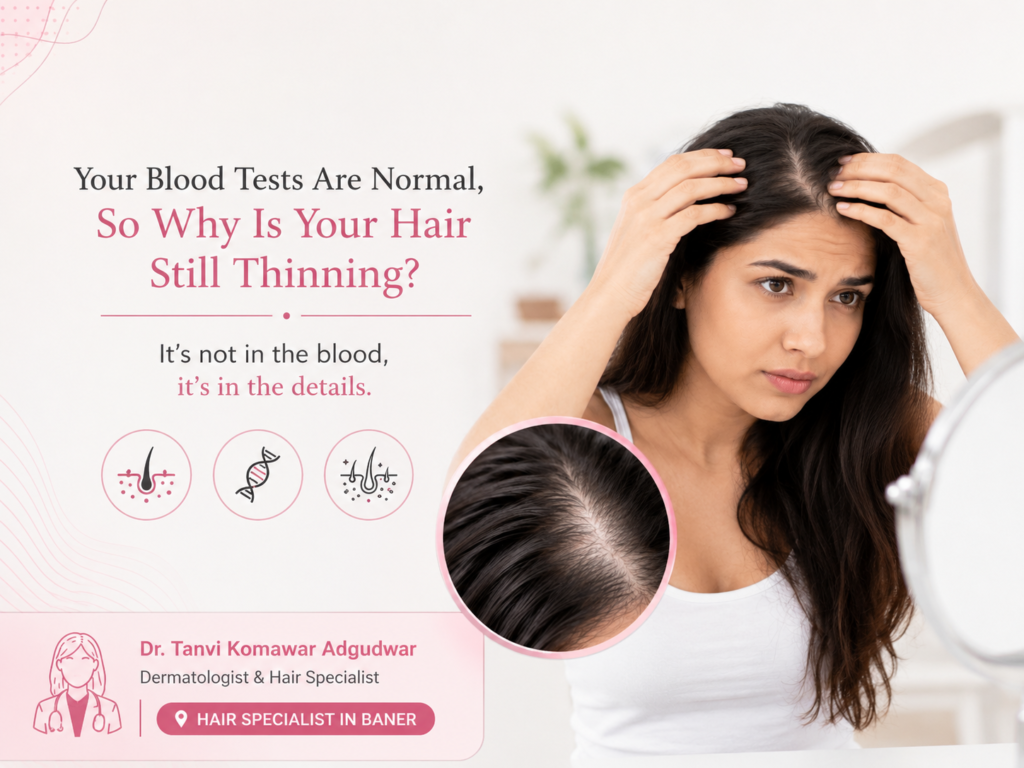
Persistent Hair Thinning Despite Normal Reports: When to Consult a Hair Specialist in Baner
You notice more scalp showing through your hair, increased shedding while washing or a widening part. You get blood tests done, and everything comes back “normal.”
So why is your hair still thinning?
Normal blood reports are reassuring, but they do not rule out every cause of hair loss. Hair thinning can result from genetics, changes in the hair growth cycle, scalp inflammation, hairstyles, medications and several other factors that may not appear on routine blood tests.
A hair specialist in Baner evaluates much more than laboratory reports. The pattern of hair loss, scalp condition, hair shaft and timeline can provide important diagnostic clues.
Hair Loss Is Not Diagnosed Through Blood Tests Alone
Hair follicles continuously move through phases of growth, transition, rest and shedding. A disturbance anywhere in this cycle can change hair density.
Blood tests can help detect selected causes such as thyroid abnormalities or nutritional deficiencies when clinically suspected. However, they cannot directly diagnose many common forms of hair loss.
The American Academy of Dermatology (AAD) emphasizes that determining the cause of hair loss often involves examining the scalp and hair along with reviewing medical and family history.
Could It Be Female Pattern Hair Loss?
Female pattern hair loss is a common cause of gradual thinning in women.
Unlike sudden shedding, it often develops slowly. Women may notice widening of the central part or decreasing density over the top of the scalp.
Genetics and sensitivity of hair follicles to hormonal signals can play important roles.
Routine hormone tests can sometimes be normal because female pattern hair loss does not necessarily require abnormally high hormone levels.
This is one reason “normal blood tests” cannot automatically rule it out.
Did Something Happen Several Months Before the Hair Fall Started?
One of the most important questions a hair specialist asks is not simply “When did your hair fall start?” but “What happened two or three months before it started?”
A condition called telogen effluvium can cause increased shedding after the body experiences a significant trigger.
Potential triggers include:
- High fever or major illness
- Surgery or hospitalization
- Rapid weight loss or restrictive dieting
- Major physiological or emotional stress
- Childbirth
- Starting or stopping certain medications
According to the British Association of Dermatologists, telogen effluvium often becomes noticeable several months after a trigger because of the timing of the hair growth cycle.
By the time shedding begins, the original illness or event may have been forgotten.
Is Your Scalp Healthy?
Hair thinning is not always a problem occurring solely within the follicle.
Inflammatory scalp conditions can contribute to shedding or make an existing hair-loss problem more noticeable.
A dermatologist may look for redness, scaling, itching, pustules, dandruff, inflammation or scarring.
Conditions such as seborrheic dermatitis, psoriasis and certain inflammatory forms of alopecia may require scalp-directed treatment.
Blood tests alone cannot identify these findings.
Could Your Hairstyle Be Contributing?
Repeated tension on hair follicles can lead to traction alopecia.
Tight ponytails, buns, braids, extensions or hairstyles that continuously pull at the hairline may gradually cause thinning.
Early traction alopecia may improve when tension is reduced. Long-standing repeated traction, however, can eventually cause permanent follicular damage.
A hair specialist may therefore examine whether thinning is concentrated around the frontal hairline or other areas exposed to repeated tension.
Are Your “Normal” Nutritional Tests Enough?
Hair loss is often blamed on vitamin deficiencies, leading people to take multiple supplements without knowing whether they need them.
Iron deficiency can contribute to hair shedding in appropriate clinical situations, and thyroid dysfunction may also affect hair.
However, taking biotin, iron, vitamin D or other supplements without confirming a deficiency is not automatically beneficial.
The AAD advises that excessive amounts of certain nutrients can actually be associated with hair loss.
Treatment should therefore target an identified problem rather than relying on random supplementation.
What Does a Hair Specialist Examine?
The distribution of thinning can provide valuable diagnostic information.
A dermatologist may evaluate the density of different scalp areas, hair shaft thickness, scalp condition and signs of inflammation or scarring.
Dermatoscopy or trichoscopy can provide a magnified view of the scalp and hair follicles. This can reveal patterns that are difficult to see with the naked eye.
Your doctor may also perform a hair-pull assessment or recommend additional investigations depending on the findings.
Could More Than One Hair-Loss Condition Be Present?
Yes.
A person may have underlying female pattern hair loss and then develop telogen effluvium after illness or rapid weight loss. The sudden shedding can make previously subtle thinning much more noticeable.
Similarly, scalp inflammation can occur alongside another hair-loss condition.
This is why looking for one abnormal blood result does not always provide the complete answer.
Should You Keep Repeating Blood Tests?
Not necessarily.
Blood tests should generally be selected based on your symptoms, medical history and examination rather than repeatedly ordering large panels without a clinical reason.
If initial investigations are normal but hair loss continues, the next step may be a detailed scalp examination rather than another identical set of blood tests.
Why Early Assessment Can Matter
Some forms of hair loss are temporary and reversible, while others can progressively reduce hair density.
Scarring forms of alopecia are particularly important to recognize because permanent follicular damage can occur.
Seek medical evaluation if thinning is rapidly progressing, occurs in patches, is accompanied by scalp pain or inflammation, or is associated with loss of eyebrows or other body hair.
Consult Dr. Tanvi Komawar Adgudwar, Hair Specialist in Baner
If your blood reports are normal but hair thinning continues, the next step is to identify the pattern rather than simply adding more supplements.
At Skin 101 Clinic, Dr. Tanvi Komawar Adgudwar, Hair specialist in Baner, evaluates hair-loss patterns, scalp health, medical history and relevant investigations to determine possible causes and guide individualized treatment.
Frequently Asked Questions
1. Can you have hair loss even when all blood tests are normal?
Yes. Female pattern hair loss, traction alopecia and several scalp-related conditions may occur despite normal routine blood tests.
2. Why is my hair thinning but I am not losing large amounts of hair?
Gradual miniaturization of follicles, as seen in pattern hair loss, can reduce overall density without dramatic daily shedding.
3. Which blood tests should be done for hair loss?
Testing depends on your history and examination. A dermatologist may consider thyroid, iron or selected nutritional or hormonal investigations when clinically appropriate rather than recommending the same tests for everyone.
#hairspecialistinbaner #hairloss #hairthinning #femalehairloss #telogeneffluvium #scalpcare #hairhealth #dermatologistinbaner #skin101clinic