
Recurring Hives and When to Consult a Dermatologist
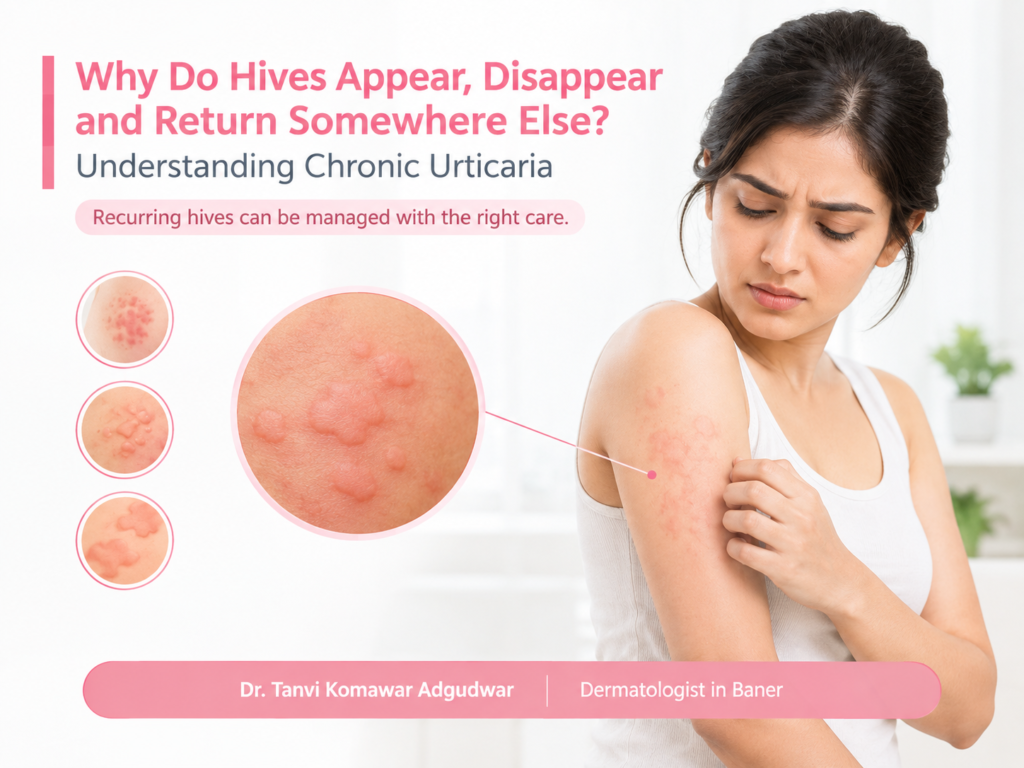
A raised, itchy patch suddenly appears on your arm. A few hours later, it disappears completely, only for another patch to show up on your back, neck or leg. This pattern can be confusing, especially when there seems to be no obvious trigger.
These temporary, raised itchy welts are commonly called hives, while the medical term is urticaria.
Individual hives can disappear quickly while new ones develop elsewhere. When episodes continue or repeatedly return for six weeks or longer, the condition is classified as chronic urticaria. The American Academy of Dermatology notes that chronic hives may continue for months or, in some people, longer.
If recurring hives are affecting sleep or everyday comfort, consulting a dermatologist in Baner can help determine whether you have chronic spontaneous urticaria, a physical form of urticaria or another skin condition.
Why Do Hives Move From One Place to Another?
Hives occur when certain cells in the skin release chemical mediators, including histamine. This causes small blood vessels to leak fluid into surrounding tissue, producing swelling, redness and itching.
A characteristic feature of urticaria is that an individual welt often lasts less than 24 hours. It can disappear without leaving a mark while completely new welts arise elsewhere.
This can make it appear as though the same rash is “travelling” across the body, but new lesions are actually forming in different locations.
The appearance can range from tiny raised bumps to large areas that join together.
Does Chronic Urticaria Mean You Have an Allergy?
Not necessarily.
People often assume that persistent hives must be caused by a food allergy. Acute hives can certainly occur after an allergic reaction, medication, infection or insect sting. Chronic urticaria, however, frequently behaves differently.
According to the American Academy of Dermatology, doctors are often unable to identify one external cause for chronic spontaneous urticaria.
In many chronic cases, the immune system itself appears to contribute to inappropriate activation of mast cells in the skin. This is why eliminating one food after another without medical guidance may not solve the problem.
What Can Trigger or Worsen Hives?
Although chronic spontaneous urticaria may have no clearly identifiable external cause, certain factors can provoke or aggravate hives in susceptible people.
These can include:
- Heat, sweating or sudden temperature changes
- Pressure or friction against the skin
- Certain medications
- Infections
- Emotional stress
- Cold exposure or sunlight in some forms of physical urticaria
Keeping a record of flare-ups can sometimes reveal a consistent pattern. The AAD specifically recommends tracking episodes because it may help identify relevant triggers.
What Is Chronic Spontaneous Urticaria?
When hives repeatedly occur for six weeks or longer without a consistently identifiable external trigger, the condition is generally called chronic spontaneous urticaria, or CSU.
The word “spontaneous” is important. It means the hives appear without a predictable external physical trigger.
This can be frustrating because people frequently undergo repeated food restrictions, allergy tests and lifestyle changes hoping to discover a single explanation.
A dermatologist usually focuses on the clinical pattern and medical history rather than automatically ordering extensive investigations for every patient.
Could Medication Be Causing Your Hives?
Certain medicines can trigger or aggravate urticaria in susceptible individuals.
This is why your dermatologist may ask about prescription medicines, over-the-counter painkillers, supplements and medications recently started or stopped.
Do not discontinue a medically necessary prescription without speaking with the doctor who prescribed it.
Sometimes medication timing provides a useful diagnostic clue, but many cases of chronic urticaria remain unrelated to a specific medicine.
When Are Hives More Serious?
Hives affecting only the skin are usually uncomfortable rather than dangerous.
However, urgent medical attention is necessary when hives occur with swelling inside the mouth or throat, breathing difficulty, trouble swallowing, faintness or other symptoms suggesting a severe allergic reaction.
The American Academy of Dermatology advises urgent care when hives are accompanied by facial or throat swelling, breathing or swallowing difficulty, light-headedness or a racing heartbeat.
How Does a Dermatologist Diagnose Chronic Urticaria?
Diagnosis begins with understanding the pattern.
A dermatologist may ask how long individual lesions remain, how often they recur, whether they leave marks and whether swelling of the lips or eyelids occurs.
Photographs taken during a flare can be useful because the skin may look completely normal by the time of your appointment.
Medical history, medications and associated symptoms are reviewed. Selected blood or other investigations may be recommended when clinical findings suggest an underlying condition, but extensive testing is not required for every person.
Why Do Some People Have Swelling Without Typical Hives?
Urticaria can sometimes occur with angioedema, which is deeper swelling beneath the skin.
It may affect the eyelids, lips, hands or other areas and can last longer than superficial hives.
Because several conditions can cause angioedema, recurrent swelling should be assessed, especially if it occurs without typical hives.
How Are Chronic Hives Treated?
Treatment aims to control symptoms and reduce flare-ups.
Non-sedating antihistamines are commonly used as first-line treatment for urticaria. Treatment may need to be adjusted according to response and should be guided by a doctor, particularly when symptoms are frequent or persistent. The AAD identifies non-drowsy antihistamines as an important part of hive management.
For chronic urticaria that remains uncontrolled, dermatologists may consider additional treatment options depending on severity and response.
Repeatedly using steroid tablets without medical supervision is not an appropriate long-term strategy.
Should You Get an Allergy Test for Every Case of Hives?
Not always.
Testing is most useful when your history suggests a specific trigger. For example, if hives consistently appear shortly after exposure to one particular substance, targeted investigation may be reasonable.
With chronic spontaneous urticaria, indiscriminate testing may provide results that are unrelated to the actual cause.
The evaluation should therefore be guided by the pattern rather than simply ordering every available test.
Consult Dr. Tanvi Komawar Adgudwar, Dermatologist in Baner
If hives keep appearing, disappearing and returning for several weeks, getting the pattern assessed can help distinguish chronic urticaria from other itchy skin conditions.
At Skin 101 Clinic, Dr. Tanvi Komawar Adgudwar, dermatologist in Baner, provides evaluation and individualized management for recurring hives and other dermatological concerns.
Proper diagnosis can also help avoid unnecessary food restrictions or repeated self-medication when no clear allergy has been established.
Frequently Asked Questions
1. Why do my hives disappear and appear somewhere else?
Individual hives often resolve within several hours while new welts develop in another location. This shifting pattern is characteristic of urticaria and does not necessarily mean the condition is physically spreading across the skin.
2. Are chronic hives always caused by food allergy?
No. Food allergy can cause acute hives, but chronic spontaneous urticaria often has no identifiable external allergen. A dermatologist can determine whether targeted allergy evaluation is appropriate.
3. When should recurring hives be checked by a dermatologist?
Consult a dermatologist when hives continue or repeatedly return for six weeks or more, significantly disturb sleep, occur frequently or are accompanied by recurrent swelling.
#chronicurticaria #hives #urticaria #dermatologistinbaner #itchyskin #skinallergy #skinhealth #dermatologist #skin101clinic