
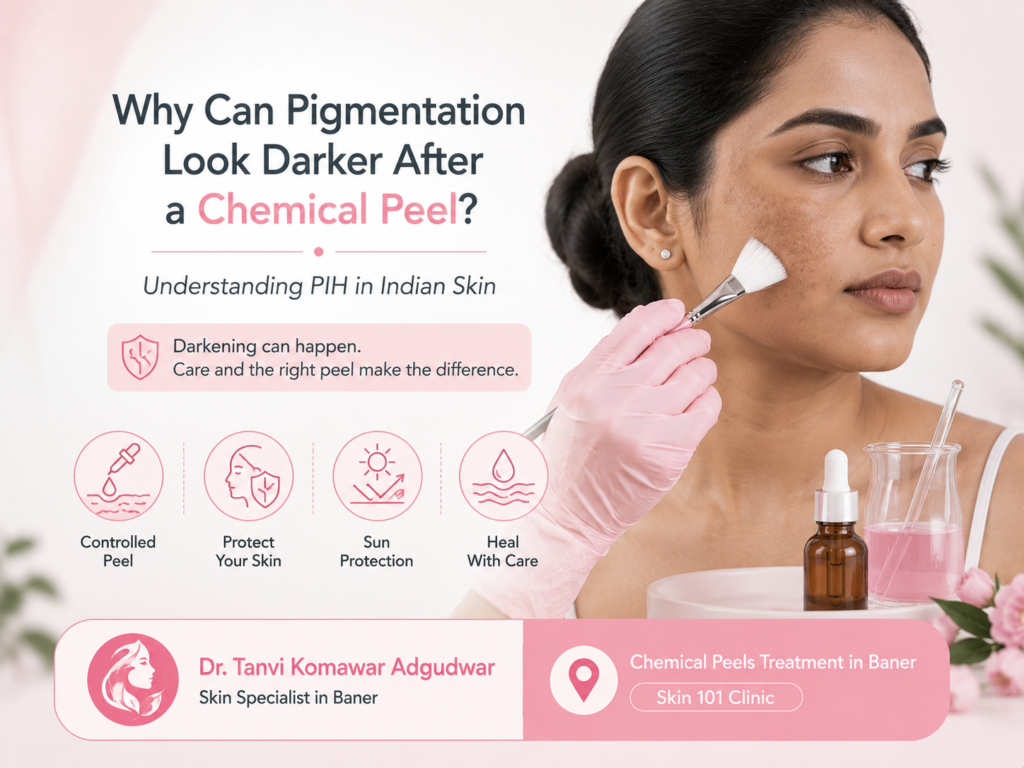
Post-Peel Pigmentation and Chemical Peel Treatment
Chemical peels are commonly used to improve acne marks, uneven skin tone and certain types of pigmentation. So it can be worrying when pigmentation appears darker instead of lighter after a peel.
This can sometimes be due to post-inflammatory hyperpigmentation, commonly shortened to PIH.
PIH occurs when inflammation or skin injury stimulates excess pigment production. Indian and other darker skin tones may be more prone to noticeable PIH, which makes careful patient selection and peel planning particularly important.
If you are considering chemical peels treatment in Baner, understanding this possibility can help you know what is expected after treatment and what needs dermatological review.
What Happens to Your Skin During a Chemical Peel?
Chemical peels use specific chemical agents to create controlled exfoliation at a selected depth.
Depending on the agent and concentration, a peel can affect superficial or deeper layers of the skin.
The goal is controlled treatment. A stronger reaction is not automatically a better result.
According to the American Academy of Dermatology (AAD), chemical peels can be used for conditions including certain types of acne, discoloration and signs of photoageing, but the procedure should be selected according to skin type and treatment goals.
What Is Post-Inflammatory Hyperpigmentation?
PIH is excess pigmentation that develops after skin inflammation or injury.
Inflammation can stimulate melanocytes to produce more melanin. As the affected area heals, it may therefore look darker than the surrounding skin.
PIH is especially relevant in darker skin phototypes because pigment-producing cells may respond strongly to inflammation.
The medical resource DermNet notes that post-inflammatory hyperpigmentation can follow various inflammatory skin disorders and tends to be more noticeable and persistent in darker skin types.
Why Can Pigmentation Become Darker After a Peel?
Several factors can contribute.
Excessive Irritation
If the skin experiences more inflammation than intended, pigment production can increase during healing.
Sun Exposure
Freshly treated skin can be particularly vulnerable to ultraviolet and visible light. Inadequate sun protection may worsen existing pigmentation or contribute to PIH.
Picking or Scrubbing Peeling Skin
Removing flaking skin manually can create additional inflammation and potentially increase pigmentation.
Other factors include choosing an unsuitable peel depth, treating already irritated skin or using strong active skincare too soon after treatment.
Why Does Indian Skin Need Careful Peel Selection?
Indian skin includes a wide range of tones and responses, so treatment cannot be based simply on ethnicity.
However, medium to deeper skin phototypes can have a greater tendency toward pigment changes after inflammation.
This does not mean chemical peels cannot be performed safely on Indian skin. It means the choice of peeling agent, concentration, contact time, preparation and aftercare should be individualized.
More aggressive treatment is not necessarily more effective for pigmentation.
Is Darkening Immediately After a Peel Always PIH?
No.
Some temporary darkening may occur as treated superficial skin becomes dry and begins to shed. Existing pigmentation can temporarily look more prominent during the healing period.
True PIH tends to persist beyond the immediate recovery phase.
If you notice significant burning, blistering, crusting or rapidly increasing pigmentation, contact your dermatologist rather than waiting for the next scheduled session.
How Can the Risk of PIH Be Reduced?
Good pre-peel and post-peel care matters.
Depending on your skin and treatment, your dermatologist may advise:
- Consistent broad-spectrum sunscreen use
- Avoiding unnecessary sun exposure
- Temporarily stopping selected irritating skincare products
- Not picking or peeling flaking skin
- Using gentle moisturizers during recovery
Your exact instructions may differ according to the peel used.
Can PIH After a Chemical Peel Be Treated?
Yes, but improvement usually requires patience.
Treatment depends on how deep the pigmentation is, your skin type and what triggered the inflammation.
Dermatologists may use topical pigment-modulating treatments, sun protection and carefully selected procedures. Immediately performing another aggressive peel over irritated skin is not necessarily appropriate.
The first priority is often to allow inflammation and the skin barrier to settle.
How Long Does Post-Inflammatory Pigmentation Take to Fade?
There is no single timeline.
Superficial pigmentation may gradually improve over weeks to months. Deeper pigment can take longer.
Continued sun exposure can prolong pigmentation, which is why photoprotection is a fundamental part of management.
When Should You Contact Your Dermatologist After a Peel?
Mild redness or peeling may occur depending on the procedure, but significant symptoms deserve attention.
Contact your dermatologist if you experience persistent intense burning, blistering, marked swelling, crusting, signs of infection or substantial new pigmentation.
Do not try to correct a reaction using strong exfoliating acids at home.
Why Professional Chemical Peel Planning Matters
Chemical peels should not be chosen simply according to the strongest concentration available.
The right peel depends on the problem being treated, skin type, previous pigmentation history, current skincare routine and how the skin responds to inflammation.
This is particularly important when treating melasma or PIH-prone skin, where excessive irritation can work against the treatment goal.
Chemical Peels Treatment in Baner at Skin 101 Clinic
If you are considering a chemical peel for pigmentation, acne marks or uneven skin tone, professional skin assessment can help determine whether a peel is suitable.
At Skin 101 Clinic, Dr. Tanvi Komawar Adgudwar provides individualized chemical peels treatment in Baner, with treatment planning based on skin type, pigmentation pattern and clinical assessment.
If pigmentation has become darker following a previous peel, evaluation can also help determine whether you are experiencing temporary post-procedure changes or post-inflammatory hyperpigmentation.
Frequently Asked Questions
1. Is it normal for skin to look darker after a chemical peel?
Temporary changes can occur while the skin heals. However, persistent darkening may represent post-inflammatory hyperpigmentation, particularly when significant irritation has occurred.
2. Can chemical peels make pigmentation permanently worse?
Pigment changes can occur after excessive inflammation, especially in PIH-prone skin. Many cases improve with appropriate management, although the timeline varies. Proper peel selection and aftercare can help reduce risk.
3. Should I get another chemical peel if pigmentation became darker?
Do not automatically repeat the procedure. A dermatologist should first assess whether the skin has healed and determine why pigmentation increased before recommending further treatment.
#chemicalpeels #chemicalpeelsinbaner #pigmentation #postinflammatoryhyperpigmentation #pih #indianskin #skincare #dermatologistinbaner #skin101clinic