
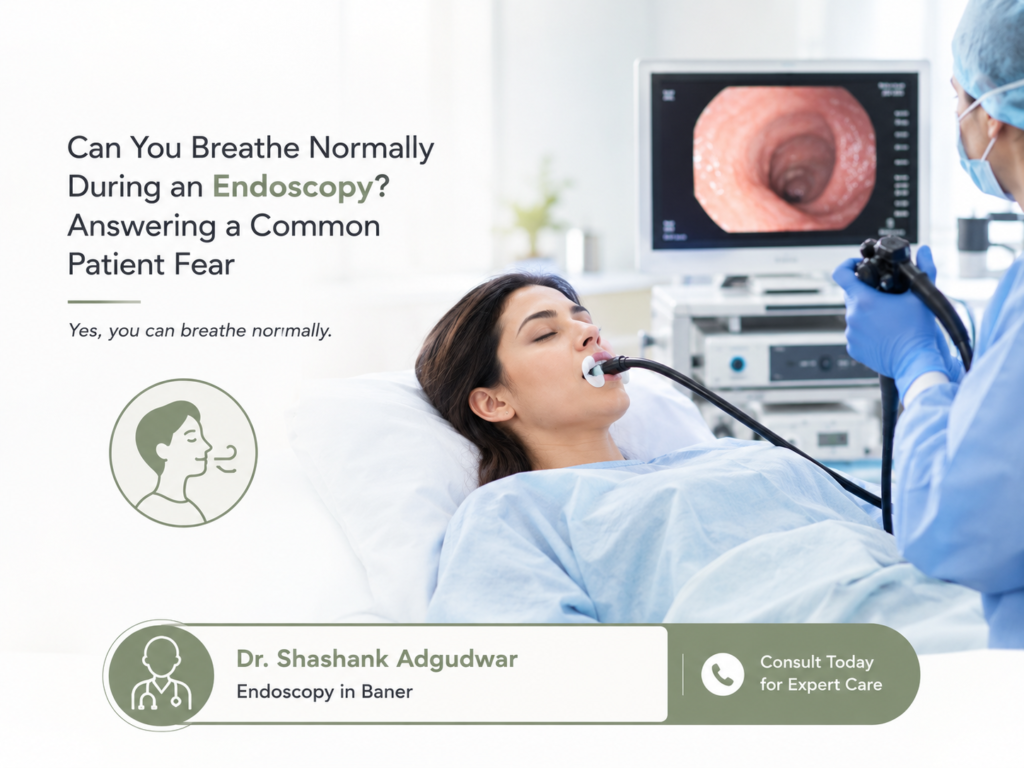
Breathing During Endoscopy in Baner: What Patients Should Know
For many patients, the most frightening part of an upper gastrointestinal endoscopy is not what the doctor might find. It is the thought of having a tube passed through the mouth and wondering, “Will I still be able to breathe?”
This fear is understandable, especially if you have never undergone endoscopy before.
During a standard upper GI endoscopy, the endoscope travels through the mouth and oesophagus into the stomach. It does not normally enter the airway used for breathing. Sedation and monitoring practices are also designed around patient safety, with established professional guidance for monitoring people undergoing gastrointestinal endoscopy.
Understanding what happens during Endoscopy in Baner can make the procedure feel much less intimidating.
Where Does the Endoscope Actually Go?
When you swallow, your throat leads into two different pathways.
The oesophagus carries food and liquid toward the stomach. The airway leads toward the lungs.
During an upper gastrointestinal endoscopy, the flexible endoscope is directed into the oesophagus, not down the windpipe.
Because breathing takes place through the airway, the presence of an endoscope in the oesophagus does not normally prevent you from breathing.
The sensation of something being present in the throat can still feel unusual, which is why reassurance and preparation are important.
Why Does It Sometimes Feel as Though You Cannot Breathe?
Anxiety can create a strong sensation of breathlessness even when airflow remains normal.
Having a mouth guard, throat spray or instrument passing through the throat may feel unfamiliar. People sometimes respond by trying to swallow repeatedly or holding their breath because they are tense.
This sensation is different from actual airway obstruction.
Endoscopy teams monitor patients throughout the procedure and are trained to recognize breathing or sedation-related problems. ASGE guidance specifically addresses monitoring and safety during sedated gastrointestinal procedures.
Can You Breathe Through Your Nose?
Yes.
Patients can normally continue breathing during an upper endoscopy.
You do not need to consciously coordinate your breathing with the movement of the endoscope.
Remaining relaxed and taking slow breaths can make the experience more comfortable. If you are awake enough to follow instructions, the endoscopy team may remind you to breathe normally and avoid repeatedly trying to swallow.
Are You Always Sedated for Endoscopy?
Not necessarily.
Upper endoscopy can be performed under different levels of sedation depending on the procedure, patient, facility and local practice.
Some patients undergo the procedure with topical throat anaesthesia and minimal or no sedation, while others receive moderate or deeper sedation.
ASGE guidance recognizes multiple sedation approaches for gastrointestinal endoscopic procedures.
Your doctor should discuss the planned approach before the procedure.
What Happens to Breathing When Sedation Is Used?
Sedating medicines can affect consciousness and, at deeper levels, may influence breathing.
This is why sedation is not simply given and ignored.
Patients undergoing endoscopy with sedation are appropriately monitored, and the clinical team is prepared to respond if oxygen levels or breathing require attention. Professional safety guidance for endoscopy addresses staffing, monitoring and sedation-related risk.
The level of monitoring depends partly on the type and depth of sedation.
What Is the Mouth Guard For?
During oral endoscopy, a small mouth guard is usually placed between the teeth.
It protects both the endoscope and your teeth from accidental biting.
It does not seal your mouth shut or stop you from breathing.
You may notice some saliva during the procedure, and the clinical team can manage secretions appropriately.
Can You Choke on the Endoscope?
The endoscope is deliberately guided into the digestive tract by a trained clinician.
Although the sensation can trigger gagging in some people, especially during insertion, gagging does not mean the endoscope is blocking the airway.
Throat numbing medicines and sedation can help reduce discomfort depending on the procedure plan.
As with any medical procedure, complications are possible, which is why endoscopy is performed with appropriate monitoring and trained staff. ASGE notes that sedation and upper endoscopy carry risks, although serious adverse events are uncommon in appropriately managed procedures.
What If You Have Asthma or Another Breathing Condition?
Tell your gastroenterologist before the procedure.
Asthma, sleep apnea, chronic lung disease, heart problems and previous reactions to sedation can all be relevant when planning an endoscopy.
Bring an accurate medication list and inform the team about inhalers or breathing devices you regularly use.
This allows the endoscopy and sedation plan to be tailored to your individual medical history.
What Happens Before Endoscopy?
You will usually receive instructions about fasting before the procedure.
The clinical team reviews relevant medications and medical history and may ask about allergies, previous anaesthesia problems and major health conditions.
If sedation is planned, additional instructions may apply regarding transportation home afterward.
Following preparation instructions is important for both procedure quality and safety.
What Should You Tell the Doctor Beforehand?
Be sure to mention:
- Asthma, COPD, sleep apnea or other breathing conditions
- Heart disease
- Previous problems with sedation or anaesthesia
- Medication allergies
- Blood-thinning medicines
- Pregnancy or possible pregnancy
- Significant swallowing difficulties
Providing complete information allows your gastroenterologist to assess whether any special precautions are needed.
How Long Does an Endoscopy Take?
The diagnostic part of a routine upper endoscopy is generally relatively brief, although total time at the facility is longer because preparation and recovery are required.
The duration can increase if biopsies or therapeutic procedures are performed.
If sedation is used, you will be observed afterward until the clinical team determines that you are ready for discharge according to the facility’s protocols.
What If You Panic During the Procedure?
Tell the team beforehand if you are particularly anxious.
Fear of choking or breathing difficulty is very common, and knowing about it allows the staff to explain the process and provide appropriate reassurance.
If you are undergoing the procedure with light or no sedation, you may still be able to communicate discomfort.
For patients who are extremely anxious, your gastroenterologist can discuss whether a different sedation plan may be suitable.
Why Understanding the Procedure Helps
Much of endoscopy anxiety comes from imagining the endoscope entering the same tube used for breathing.
Anatomically, this is not what happens.
The endoscope travels through the oesophagus toward the stomach while your airway remains separate. Monitoring is used particularly when sedation is administered.
Knowing this before the procedure can make it easier to remain relaxed.
Endoscopy in Baner at Surgery 101 Clinic
If you have been advised to undergo endoscopy and are worried about breathing, gagging or sedation, discuss these concerns before the procedure rather than postponing an important investigation because of fear.
At Surgery 101 Clinic, Dr. Shashank Adgudwar provides endoscopy in Baner for appropriate gastrointestinal indications, with the procedure planned according to the patient’s symptoms and medical history.
Frequently Asked Questions
1. Can I breathe normally while an endoscopy tube is in my throat?
Yes. The endoscope travels through the oesophagus toward the stomach rather than through the airway, so patients can normally continue breathing during an upper endoscopy.
2. Can endoscopy make you choke?
Gagging can occur, particularly during insertion, but this is different from choking. Patients are appropriately monitored throughout the procedure, especially when sedation is used.
3. Is sedation necessary for every endoscopy?
No. Different sedation approaches may be used depending on the patient, procedure and facility. Your gastroenterologist can explain which option is appropriate for you.
#endoscopyinbaner #endoscopy #gastroscopy #gastroenterologistinbaner #digestivehealth #endoscopyprocedure #stomachhealth #surgery101clinic