
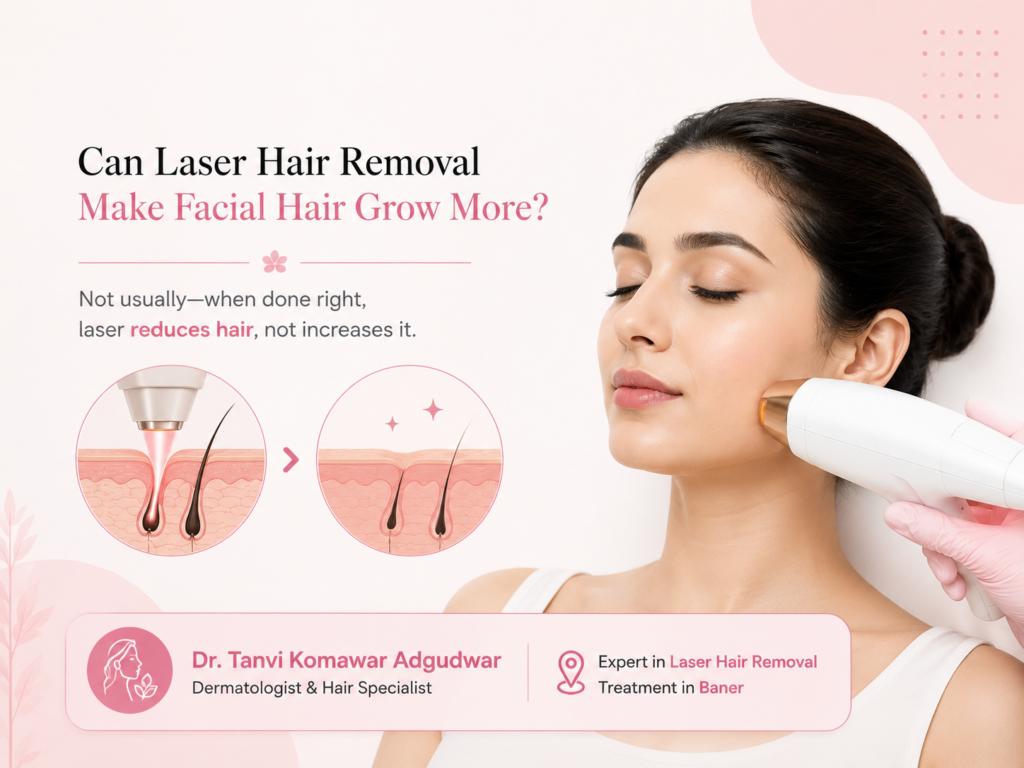
Understanding Paradoxical Hair Growth After Laser Hair Removal Treatment in Baner
Laser hair removal is chosen by many people hoping to reduce unwanted facial hair and avoid frequent threading, waxing or shaving. When performed appropriately, laser treatment is designed to produce long-term hair reduction by targeting pigment within the hair follicle. The FDA uses the term permanent hair reduction to describe a long-term, stable reduction in the number of hairs that regrow after treatment.
But occasionally, something unexpected happens. Instead of becoming finer and fewer, hairs in or around the treated area may appear darker, thicker or more noticeable.
This phenomenon is known as paradoxical hypertrichosis, or paradoxical hair growth.
It is a recognized but uncommon adverse effect of laser and intense pulsed light hair removal. Research suggests that it is seen more often in certain anatomical areas, particularly the face and neck.
If you are considering laser hair removal treatment in Baner, understanding why paradoxical hair growth can occur and how treatment planning may reduce the risk is important.
What Is Paradoxical Hair Growth?
Paradoxical hypertrichosis refers to increased hair growth following a procedure that was actually intended to reduce hair.
Instead of treated hair becoming progressively finer, some hairs may become more visible or develop into thicker terminal hairs. The increase can sometimes appear within the treated zone or near its margins.
A systematic review and meta-analysis published in Lasers in Surgery and Medicine described paradoxical hypertrichosis as an uncommon and still incompletely understood adverse effect associated with laser or intense pulsed light hair removal.
The exact biological mechanism has not been fully established, so it is important to avoid oversimplified explanations such as saying that “laser always stimulates hair if the settings are low.”
Why Can Laser Hair Removal Sometimes Stimulate Hair?
Laser hair reduction works by delivering light energy that is absorbed by pigment in the hair. That energy is converted into heat, which can damage structures involved in hair production.
Hair characteristics matter. Thick, dark hairs usually contain more melanin and therefore provide a clearer target than very fine, light or barely visible facial hairs.
One theory behind paradoxical growth is that insufficient heat may fail to adequately damage certain follicles while still creating enough thermal stimulation to alter nearby follicles. Older reviews have proposed suboptimal fluence and stimulation of dormant follicles as possible mechanisms, but these remain theories rather than fully proven explanations.
Research has also questioned whether all hair growth noticed after treatment is truly caused by laser exposure. In some cases, an underlying hormonal condition or natural progression of facial hair may contribute to the apparent increase.
This is why a dermatologist should assess the overall pattern rather than automatically blaming every new facial hair on the previous treatment.
Why Is Facial Hair More Prone to This Problem?
Paradoxical hypertrichosis has been reported particularly around facial and neck treatment areas.
A 2021 systematic review and meta-analysis found that paradoxical hypertrichosis was strongly associated with treatment location, with the face and neck accounting for most reported cases.
One reason may be that the face often contains a mixture of coarse terminal hairs and much finer vellus or intermediate hairs. Treating areas dominated by very fine hair may produce a less predictable response compared with treating clearly coarse, pigmented hair.
This is particularly important when someone wants laser treatment over the entire cheeks, sideburn area, jawline or neck despite having only sparse fine hair.
A proper consultation before laser hair removal treatment should therefore assess whether the hair present is actually a suitable target for the chosen device.
Who May Have a Higher Risk of Paradoxical Hair Growth?
Risk cannot be predicted perfectly, but several patient and treatment characteristics have been investigated.
A 2025 study examining facial paradoxical hypertrichosis after Alexandrite laser treatment found associations with factors including PCOS, irregular menstrual cycles, a family history of hirsutism and Fitzpatrick skin types III and IV.
Factors that may deserve particular consideration include:
- Predominantly fine facial hair rather than coarse terminal hair
- Hormonal conditions associated with increased facial hair, including PCOS
- Irregular menstrual cycles or other signs suggesting androgen-related hair growth
- Certain skin and hair combinations that require especially careful laser selection and parameter adjustment
- Treatment of large surrounding areas containing fine hairs
These factors do not mean someone will definitely develop paradoxical growth. They simply reinforce the need for individualized assessment.
Does PCOS Affect Laser Hair Removal Results?
PCOS can cause or contribute to excess facial and body hair because increased androgen activity may stimulate terminal hair growth.
Laser can reduce existing pigmented hair, but it does not correct the underlying hormonal tendency that may produce new hairs over time.
This distinction matters.
If facial hair is rapidly increasing or is accompanied by irregular periods, persistent acne, scalp hair thinning or other hormonal symptoms, dermatological treatment alone may not be enough. Appropriate medical evaluation for hormonal causes may be recommended.
The 2025 study mentioned above found a higher occurrence of facial paradoxical hypertrichosis among participants with PCOS, although additional research is needed to understand the relationship fully.
Does Using a Low Laser Setting Always Cause More Hair?
No. This is one of the biggest misconceptions surrounding paradoxical hair growth.
Research has discussed inadequate or subtherapeutic energy as one possible mechanism, but laser parameters cannot be judged simply as “high” or “low.”
Appropriate energy depends on multiple factors, including skin type, hair thickness, hair colour, device wavelength, spot size, pulse duration and treatment area.
Settings that are suitable for one person may be inappropriate for another.
The broader scientific literature on light-assisted hair removal shows that adverse effects are influenced by factors including skin type, anatomical region, the device used and treatment parameters.
Increasing energy indiscriminately is not a solution because excessive energy can increase the risk of burns and pigment changes.
How Can the Risk Be Reduced During Laser Hair Removal Treatment?
Good patient selection and treatment planning are important.
Before facial laser treatment, a dermatologist should ideally evaluate the type and distribution of hair rather than simply treating every visible hair across the entire face.
Helpful precautions can include:
- Assessing whether the hairs are sufficiently coarse and pigmented to be appropriate laser targets
- Choosing a laser system suitable for the person’s skin type and hair characteristics
- Using clinically appropriate treatment parameters instead of standardized settings for every patient
- Reviewing hormonal symptoms when facial hair is unusually dense or progressively increasing
- Monitoring response between sessions before automatically expanding the treatment area
Avoiding unnecessary treatment of fine facial hair can also be an important part of treatment planning.
What If Your Facial Hair Has Increased After Laser?
Do not immediately book repeated sessions using exactly the same approach.
First, compare the area with photographs taken before treatment if available. This can help determine whether there has truly been an increase in hair density or thickness.
A dermatologist may then assess whether the change represents paradoxical hypertrichosis, normal hair cycling, incomplete treatment response or progression of an underlying hormonal hair-growth pattern.
Further management depends on the findings.
Some cases of paradoxical growth have been treated with additional laser sessions using appropriately selected parameters. Published case reports and clinical studies show that paradoxical hair growth can sometimes respond to further carefully planned laser treatment.
However, repeating treatment without reassessment may not be appropriate.
Should You Stop Laser Hair Removal Completely?
Not necessarily.
Paradoxical hair growth is a recognized complication, but it does not mean laser hair removal is unsafe or ineffective for everyone.
Laser hair reduction remains widely used, and FDA-cleared laser devices are indicated for hair removal and long-term hair reduction.
The key difference is patient selection and individualized treatment.
Coarse, dark hairs generally provide a much clearer laser target than fine, lightly pigmented hairs. Facial treatment therefore requires careful evaluation because different parts of the same face may contain very different hair types.
Why Professional Assessment Matters for Facial Laser Hair Removal
Facial hair is not always purely cosmetic.
An increase in coarse chin, jawline or upper-lip hair can sometimes be influenced by hormonal factors. Starting repeated laser sessions without examining the pattern may reduce visible hair temporarily while overlooking the reason it is developing.
Similarly, treating fine facial hair simply because it is noticeable under bright light may not always provide the desired outcome.
A dermatologist can assess the skin type, hair thickness, hair distribution, previous laser history and possible hormonal clues before recommending treatment.
Laser Hair Removal Treatment in Baner at Skin 101 Clinic
If you are considering facial laser hair removal or have noticed increased hair after previous sessions, a personalized assessment can help determine the most appropriate next step.
At Skin 101 Clinic, Dr. Tanvi Komawar Adgudwar provides dermatological evaluation and laser hair removal treatment in Baner, with treatment planning based on the individual’s skin type, hair characteristics and clinical history.
If facial hair has unexpectedly become thicker or more widespread after laser treatment, getting it evaluated before continuing the same treatment protocol can help distinguish paradoxical hair growth from hormonal or other causes.
Frequently Asked Questions
1. Can laser hair removal actually make facial hair thicker?
In uncommon cases, laser or IPL treatment can be followed by increased or thicker hair growth, a phenomenon called paradoxical hypertrichosis. Research suggests it occurs particularly in facial and neck areas. However, other causes of increasing facial hair, including hormonal factors, should also be considered.
2. Is paradoxical hair growth permanent?
Not necessarily. The course varies between individuals. Published reports indicate that some cases can improve with additional appropriately planned laser treatment, but the area should first be assessed to confirm the cause and choose suitable treatment parameters.
3. Who should avoid laser treatment for fine facial hair?
There is no single rule that applies to everyone, but very fine or lightly pigmented facial hairs can be less suitable laser targets than coarse dark hairs. People with extensive fine facial hair or signs of hormonal hair growth should have a dermatological assessment before treatment so that the expected benefits and potential risks can be discussed.
#laserhairremoval #laserhairremovaltreatment #laserhairremovalinbaner #paradoxicalhairgrowth #paradoxicalhypertrichosis #facialhairremoval #facialhair #dermatologistinbaner #skin101clinic #skincare