
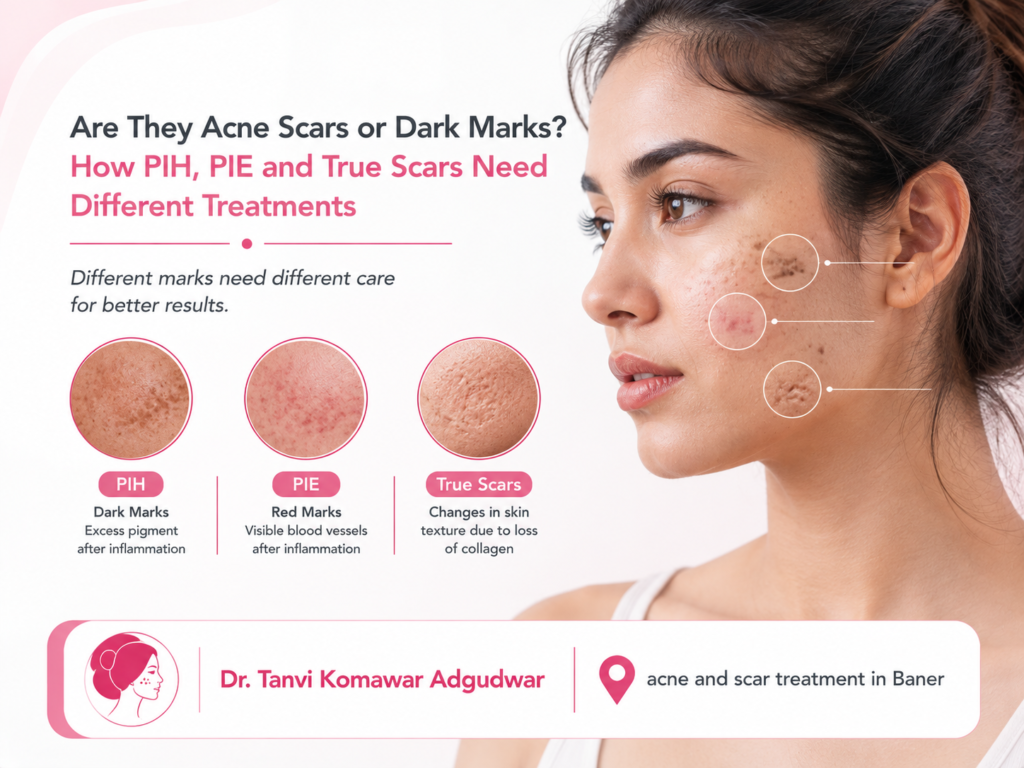
Understanding What Acne Leaves Behind Before Acne and Scar Treatment in Baner
Your acne has finally settled, but the reminders remain. Some spots are brown, others look red or pink, while a few have left visible dents in the skin.
They are often all described as “acne scars,” but medically they are not the same.
Brown marks may represent post-inflammatory hyperpigmentation (PIH). Red or pink marks may be post-inflammatory erythema (PIE). Indented or raised changes in skin texture are more likely to represent true acne scars.
Knowing the difference matters because the treatment that helps pigmentation may do very little for an indented scar. Before undergoing acne and scar treatment in Baner, identifying what acne has actually left behind is an important first step.
Why Does Acne Leave Marks?
Acne causes inflammation within the skin.
As inflammation settles, the skin begins repairing itself. Depending on the depth and intensity of inflammation, this healing process can leave changes in pigment, blood vessels or collagen.
The American Academy of Dermatology (AAD) notes that inflammatory acne can leave dark spots as well as permanent scars.
The risk of scarring generally increases with deeper inflammatory acne, particularly nodules and cysts.
Picking or squeezing lesions can add additional trauma and increase the likelihood of both discoloration and scarring.
What Is Post-Inflammatory Hyperpigmentation?
PIH refers to darker pigmentation that remains after inflammation has healed.
It happens because inflammation stimulates increased melanin production or alters how pigment is distributed within the skin.
PIH commonly appears brown, dark brown or greyish depending on skin tone and the depth of pigment.
It is particularly noticeable in medium and deeper skin tones.
DermNet describes PIH as temporary pigmentation that follows skin injury or an inflammatory disorder.
Importantly, PIH is not a true scar because the skin’s texture may remain normal.
What Is Post-Inflammatory Erythema?
PIE refers to persistent red, pink or purplish marks that can remain after acne inflammation resolves.
These marks are related more to changes in superficial blood vessels than excess melanin.
PIE may be particularly noticeable in lighter skin tones, although redness can occur across different complexions.
This distinction matters because pigment-targeting treatments designed for brown PIH may not be the best option for predominantly vascular red marks.
What Does a True Acne Scar Look Like?
True acne scars involve a structural change in the skin caused by altered collagen during healing.
Atrophic scars create depressions in the skin. Dermatologists often describe them as ice-pick, boxcar or rolling scars depending on their shape and depth.
Some people instead develop raised scars due to excessive scar tissue.
Because true scars involve changes in skin structure, creams designed only to lighten pigmentation cannot rebuild the missing collagen sufficiently to correct established depressions.
How Can You Tell Marks From Scars?
A simple clue is texture.
If you run your fingers across an area and the skin feels relatively smooth but looks brown or red, the problem may primarily involve pigmentation or vascular change.
If the skin has visible pits, depressions or raised areas, structural scarring is more likely.
Many people have a combination.
For example, one acne lesion may leave a brown mark while another deeper inflammatory lesion produces both pigmentation and an indented scar.
This is why acne scar treatment should be planned according to what is actually present.
Why Do PIH, PIE and Scars Need Different Treatments?
They involve different structures within the skin.
PIH involves melanin. PIE predominantly involves persistent vascular changes. Atrophic acne scars involve loss or remodeling of collagen.
Using the same procedure for all three may therefore produce disappointing results.
Treatment for PIH
Management may include:
- Daily sun protection
- Selected topical pigment-reducing medicines
- Retinoids or other acne-directed treatment where appropriate
- Carefully selected chemical peels or procedures
Preventing new acne is equally important because every new inflammatory lesion can create another mark.
Treatment for True Acne Scars
Depending on scar type, dermatologists may consider procedures such as microneedling, fractional laser treatment, subcision, chemical reconstruction techniques or other scar-specific approaches.
Not every procedure is suitable for every scar.
Why Does Scar Type Matter So Much?
Different scars respond differently.
A narrow, deep ice-pick scar behaves differently from a broad rolling depression caused partly by fibrous bands beneath the skin.
Trying to treat both with exactly the same procedure may limit improvement.
Dermatologists therefore often classify scars before recommending treatment. Combination approaches may sometimes be used when several scar types are present.
Should Active Acne Be Treated Before Scars?
Usually, controlling ongoing acne is an important priority.
If new inflammatory lesions continue developing while scar procedures are being performed, new marks and scars may continue appearing.
The AAD emphasizes early and effective acne treatment as an important way to help reduce the risk of scarring.
Once active acne is reasonably controlled, attention can increasingly shift toward residual pigmentation and scars.
Can Acne Marks Fade Without Treatment?
Many superficial post-inflammatory marks can gradually fade, but the process may take months.
Sun exposure can make pigmentation more noticeable and prolong its appearance.
True indented acne scars generally do not disappear in the same way because they represent structural changes in collagen.
Treatment expectations therefore need to differ for marks and scars.
Why Home Remedies Can Make Marks Worse
People often try lemon juice, scrubs, concentrated acids or aggressive exfoliation to remove acne marks quickly.
These approaches can irritate the skin and trigger additional inflammation. In pigment-prone skin, irritation itself can create more PIH.
Gentle skincare and appropriately selected treatment are safer than repeatedly trying to peel away pigmentation at home.
When Should You See a Dermatologist?
Consider professional assessment if acne marks persist for several months, pigmentation is becoming darker, or you have visible indented or raised scars.
Early consultation is also worthwhile when active acne continues to produce deep painful lesions because preventing new scars may be easier than treating established ones.
Acne and Scar Treatment in Baner at Skin 101 Clinic
If you are unsure whether the spots left by acne are pigmentation, redness or true scars, a dermatological assessment can help identify the difference before treatment begins.
At Skin 101 Clinic, Dr. Tanvi Komawar Adgudwar provides individualized acne and scar treatment in Baner based on active acne, skin type, pigmentation pattern and scar characteristics.
The aim is to select treatment according to what your skin actually needs rather than treating every post-acne mark as the same type of scar.
Frequently Asked Questions
1. How do I know if I have acne scars or just dark marks?
Dark or red marks usually change the colour of otherwise smooth skin. True acne scars alter skin texture and may appear as depressions or raised areas. A dermatologist can distinguish mixed patterns.
2. Can acne pigmentation disappear completely?
Many superficial post-inflammatory marks gradually become lighter over time, particularly with sun protection and appropriate treatment. The timeline varies according to skin tone, pigment depth and ongoing acne.
3. What is the best treatment for acne scars?
There is no single best procedure for every scar. Treatment depends on whether scars are ice-pick, boxcar, rolling or raised and whether pigmentation or active acne is also present. A combination approach may be appropriate in selected cases.
#acneandscartreatment #acnescartreatmentinbaner #acnescars #acnemarks #pih #postinflammatoryhyperpigmentation #acnetreatment #dermatologistinbaner #skin101clinic