
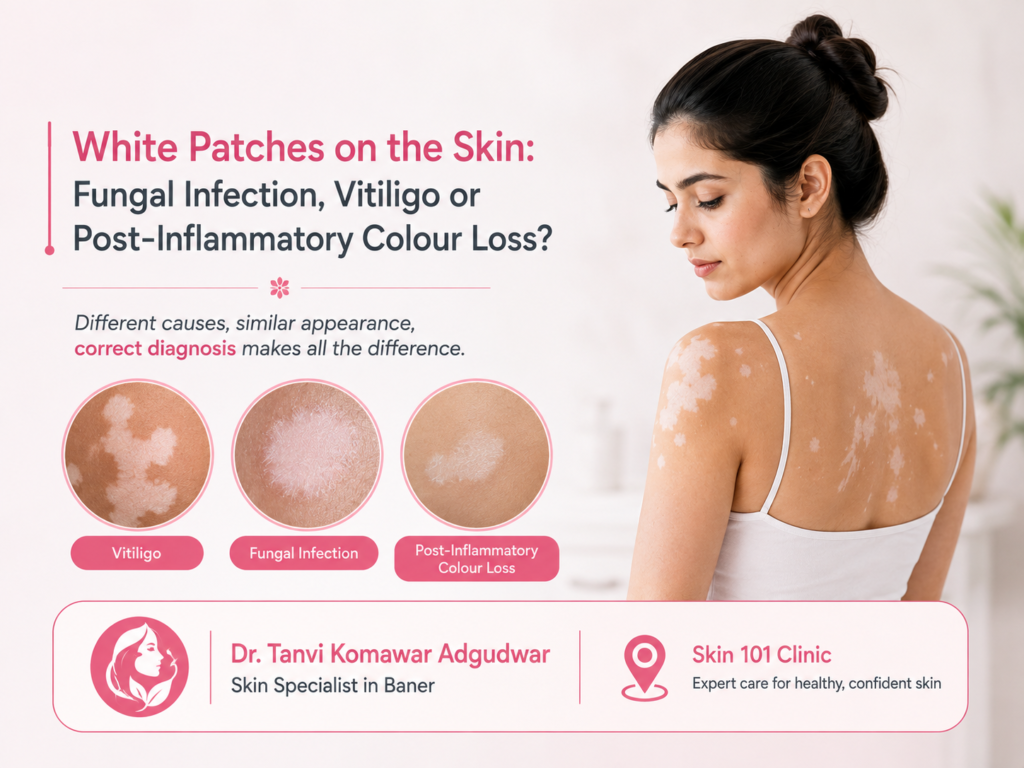
White Skin Patches: When to Consult a Skin Specialist in Baner
A pale or white patch appearing on the face, arms or body often creates immediate concern. Many people assume it is either a fungal infection or vitiligo.
But not every light-coloured patch has the same cause.
Some patches occur because pigment-producing cells are affected. Others develop after inflammation or infection, while certain superficial fungal conditions can also make areas appear lighter than surrounding skin.
A skin specialist in Baner can distinguish between these possibilities by examining the colour, texture, location and progression of the patches.
Is Every White Patch Vitiligo?
No.
Vitiligo is an autoimmune condition in which melanocytes, the cells responsible for producing skin pigment, are damaged.
According to the American Academy of Dermatology (AAD), vitiligo typically produces areas of skin that lose their natural colour and may become completely white.
However, several other conditions can create lighter skin without complete pigment loss.
This distinction is called depigmentation versus hypopigmentation. Depigmented skin has lost pigment more completely, while hypopigmented areas simply contain less pigment than surrounding skin.
Could the White Patch Be a Fungal Infection?
A superficial fungal condition called pityriasis versicolor, also known as tinea versicolor, can produce lighter or sometimes darker patches.
It is associated with an overgrowth of Malassezia yeast that normally lives on the skin.
The patches often occur on the chest, back, shoulders or neck and may have fine scaling.
The British Association of Dermatologists notes that skin colour may take several months to return to normal even after the yeast has been successfully treated.
This means persistent colour difference after antifungal treatment does not necessarily mean the infection is still active.
What Does Vitiligo Usually Look Like?
Vitiligo often creates clearly defined areas of pigment loss. Patches can develop on different parts of the body and may gradually enlarge.
Hair growing within an affected area can sometimes turn white.
Vitiligo is not contagious and cannot spread from one person to another through touching, sharing food or normal contact.
The World Health Organization recognizes vitiligo as a chronic autoimmune condition and emphasizes that misconceptions surrounding it can contribute to stigma.
What Is Post-Inflammatory Hypopigmentation?
Sometimes skin becomes lighter after inflammation has settled.
This is called post-inflammatory hypopigmentation.
It may occur after:
- Eczema or dermatitis
- Certain infections
- Skin injury or irritation
- Other inflammatory skin conditions
Unlike vitiligo, pigment-producing cells may still be present, and colour can gradually improve depending on the underlying cause and depth of inflammation.
Can Eczema Cause Light Patches on the Face?
Yes.
One common condition, especially in children and younger people, is pityriasis alba. It produces mildly scaly, lighter patches that are commonly noticed on the face.
These patches can appear particularly obvious after sun exposure because surrounding skin becomes darker while the affected area tans less.
Pityriasis alba is associated with mild dermatitis and is different from vitiligo.
How Does a Dermatologist Tell the Difference?
The diagnosis often starts with careful examination.
A dermatologist considers the borders, colour, scaling, location and whether patches are expanding.
A Wood’s lamp examination may sometimes help evaluate pigment changes. Under specific ultraviolet light, vitiligo can become more clearly visible.
When fungal infection is suspected, skin scrapings may sometimes be examined.
In unusual or uncertain cases, additional testing may be required.
Why Self-Treating Every White Patch With Antifungal Cream Can Be a Problem
Because fungal infections are common, many people automatically apply antifungal medication when they see a pale patch.
This may delay diagnosis if the actual condition is vitiligo, dermatitis or another pigment disorder.
Using steroid-containing combination creams without medical advice can create additional problems, including skin thinning and masking of certain infections.
The correct treatment depends entirely on the diagnosis.
When Should You Get White Patches Checked?
Consult a dermatologist when a patch is rapidly expanding, new patches keep appearing, the area becomes completely white or hair within the patch changes colour.
Evaluation is also useful when treatment for a presumed fungal infection has not helped or when you are uncertain about the diagnosis.
Early assessment is particularly valuable if vitiligo is suspected because treatment decisions depend partly on whether the condition is active or stable.
Can Skin Colour Return?
That depends on the cause.
Colour changes following inflammation or fungal infection can gradually improve. Vitiligo behaves differently and may require treatment aimed at controlling disease activity and encouraging repigmentation where possible.
No single outcome can be guaranteed, and response varies by location, duration and individual characteristics.
Consult Dr. Tanvi Komawar Adgudwar, Skin Specialist in Baner
If you have developed unexplained white or lighter patches, avoid assuming they are fungal infection or vitiligo based only on photographs online.
At Skin 101 Clinic, Dr. Tanvi Komawar Adgudwar, skin specialist in Baner, evaluates pigmentary conditions and other skin concerns to establish an appropriate diagnosis and treatment plan.
Frequently Asked Questions
1. How can I tell if a white patch is fungal or vitiligo?
Fungal patches may have subtle scaling and commonly occur on the trunk, while vitiligo usually causes more complete pigment loss. However, appearance can overlap, so a dermatologist should confirm the diagnosis.
2. Does every white patch spread?
No. Some lighter patches caused by inflammation or fungal conditions may remain localized and gradually improve. Vitiligo can also behave differently between individuals.
3. Are white patches contagious?
Vitiligo and post-inflammatory colour loss are not contagious. Some fungal skin conditions can involve microorganisms, but the diagnosis should first be confirmed before treatment.
#skinspecialistinbaner #whitepatches #vitiligo #fungalinfection #skinpigmentation #hypopigmentation #skinhealth #dermatologistinbaner #skin101clinic